AI Development Services in Orange County: Build Smarter, Faster, and Cost-Efficient Software
🎙️ Dive Deeper with Our Podcast!
Summary:
Orange County businesses are racing to adopt AI-driven development to stay competitive in 2026. Custom AI software development transforms operations through intelligent automation, predictive analytics, and seamless integration with tools like ChatGPT and Microsoft Copilot. Local companies working with experienced AI development partners achieve faster deployment cycles, reduced operational costs, and scalable solutions tailored to their unique workflows. Whether you’re automating customer service, optimizing supply chains, or building proprietary ML models, choosing the right AI development services in Orange County determines your project’s success. This guide explores how decision-makers can leverage AI automation for businesses in California while avoiding common implementation pitfalls.
Why Orange County Businesses Are Investing in AI Development Services Right Now
The Southern California technology landscape has shifted dramatically. Companies across Irvine, Newport Beach, Santa Ana, and surrounding Orange County cities face mounting pressure to modernize operations while competitors deploy AI-powered tools that deliver measurable ROI within months.
CTOs and operations leaders consistently report three critical challenges when evaluating AI development services Orange County providers:
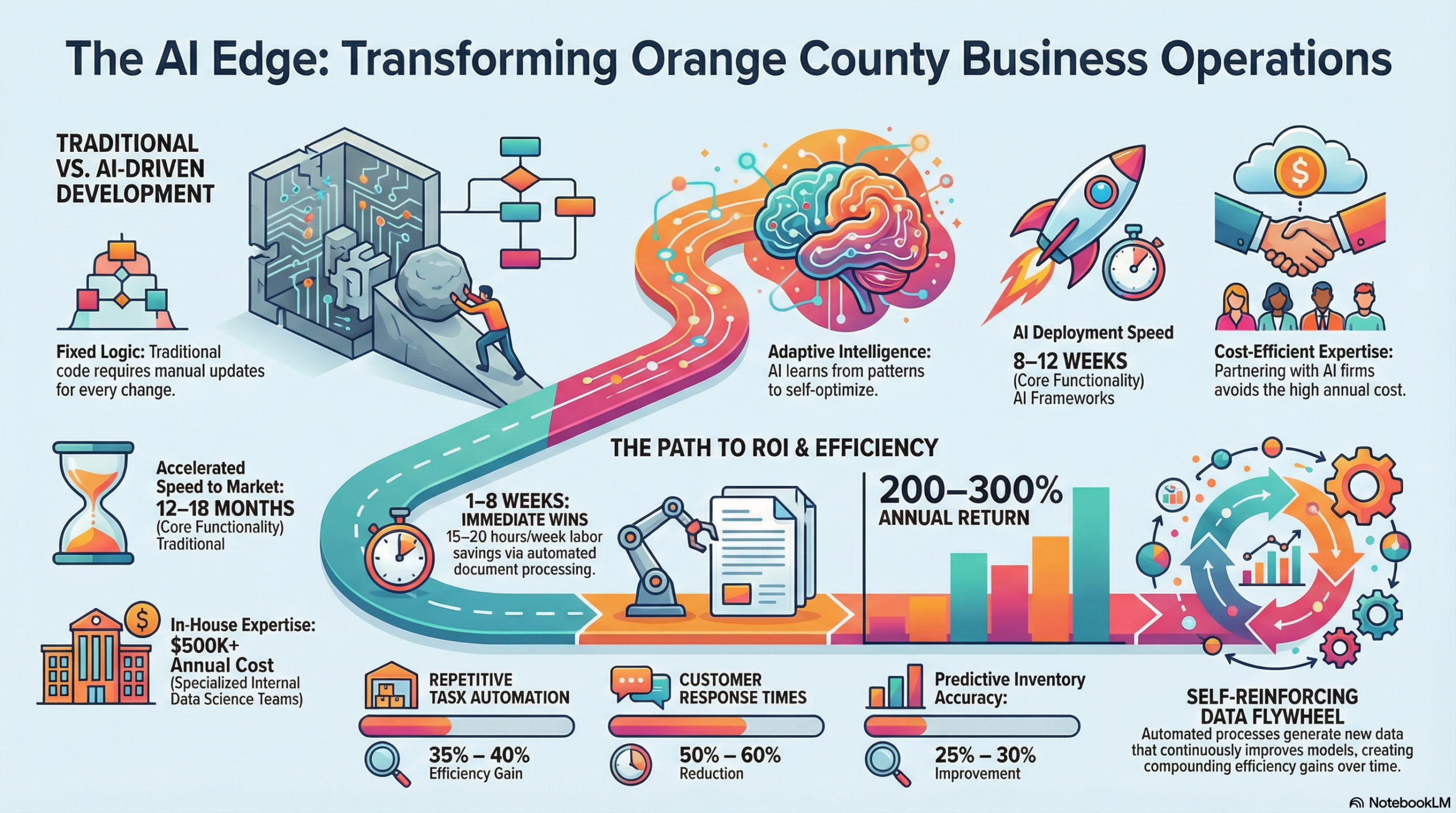
Speed to market: Traditional software development cycles spanning 12-18 months no longer meet business demands. AI-driven development frameworks reduce initial deployment windows to 8-12 weeks for core functionality, with iterative improvements following rapid testing cycles.
Cost efficiency: Building internal AI expertise requires hiring specialized data scientists, ML engineers, and infrastructure specialists—often exceeding $500K annually in personnel costs alone. Partnering with established AI development firms provides immediate access to cross-functional teams without long-term overhead.
Integration complexity: Legacy systems create technical debt that complicates AI adoption. Modern custom AI software development approaches prioritize backward compatibility, allowing businesses to enhance existing workflows rather than replace entire technology stacks.
Orange County’s diverse economy—from healthcare systems and financial services to manufacturing and professional services—creates unique AI application opportunities. Companies implementing targeted AI solutions report 35-40% efficiency gains in repetitive task automation, 25-30% improvement in predictive accuracy for inventory and demand planning, and 50-60% reduction in customer response times through intelligent chatbots and virtual assistants.
What Makes AI-Driven Development Different from Traditional Software Development?
AI-driven development represents a fundamental shift in how software solutions adapt, learn, and improve over time. Unlike conventional applications following predetermined logic paths, AI-powered systems continuously refine their performance based on data patterns and user interactions.
Traditional development relies on explicit programming—developers write specific rules for every scenario. When conditions change, engineers must manually update code, test modifications, and redeploy applications. This approach works well for stable, predictable workflows but struggles with dynamic environments requiring constant adaptation.
AI-driven development leverages machine learning models that identify patterns within operational data, automatically adjusting responses without manual intervention. These systems improve accuracy through exposure to real-world scenarios, creating self-optimizing applications that become more valuable over time.
Consider customer service automation: A traditional chatbot follows scripted response trees, failing when customers ask unexpected questions. An AI-powered solution trained on historical support conversations understands context, sentiment, and intent—resolving 70-80% of inquiries without human escalation while learning from each interaction.
The practical implications for AI automation for businesses California include:
Adaptive intelligence: Systems recognize changing patterns in customer behavior, market conditions, or operational metrics, automatically adjusting recommendations and actions.
Predictive capabilities: Rather than reacting to events, AI models forecast outcomes based on historical trends, enabling proactive decision-making for inventory, staffing, and resource allocation.
Natural language processing: Modern AI development integrates conversational interfaces that understand industry-specific terminology, allowing employees to interact with complex systems through simple dialogue.
Computer vision applications: Manufacturing and quality control processes benefit from AI models that detect defects, monitor equipment conditions, and ensure compliance standards with superhuman consistency.
Businesses adopting AI-driven methodologies gain competitive advantages through faster iteration cycles, reduced maintenance overhead, and solutions that improve performance without ongoing development costs. The technology stack—combining frameworks like TensorFlow, PyTorch, and cloud-native ML platforms—enables rapid prototyping and scaling that traditional development timelines cannot match.
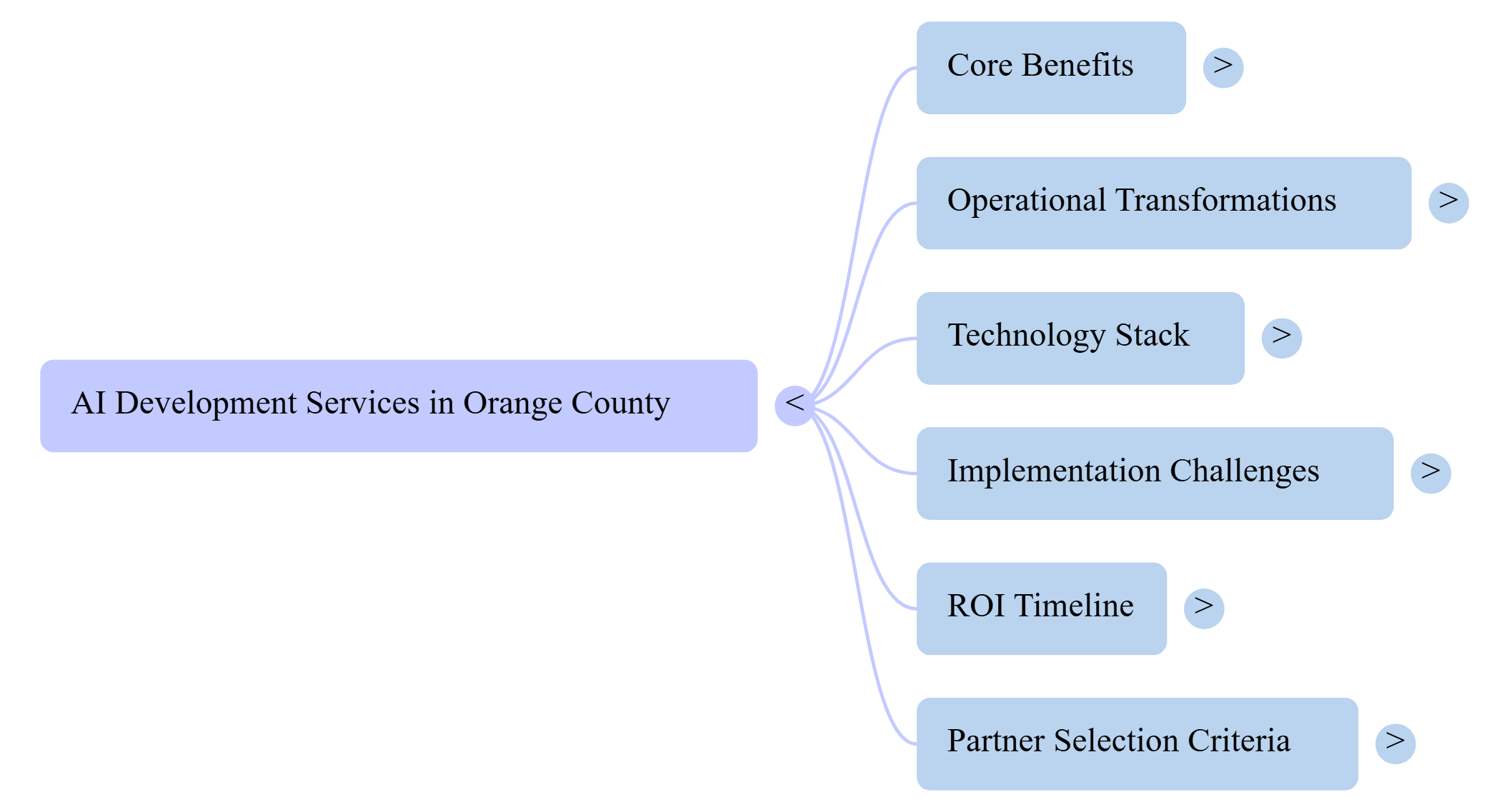
How AI Development Services Transform Orange County Business Operations
Forward-thinking Orange County companies are deploying custom AI software development across every operational function, discovering applications that extend far beyond simple automation.
Intelligent Customer Engagement
AI-powered customer interaction platforms analyze communication patterns, purchase history, and sentiment to deliver personalized experiences at scale. Local retailers and service providers implement:
- Conversational AI assistants that handle appointment scheduling, product recommendations, and technical support across multiple channels simultaneously
- Predictive lead scoring that identifies high-value prospects based on behavioral signals, allowing sales teams to prioritize outreach efforts
- Sentiment analysis tools that monitor customer feedback across social media, reviews, and support tickets, flagging satisfaction issues before they escalate
A Newport Beach financial services firm recently deployed custom AI chatbots integrated with their CRM system, reducing first-response times from 4 hours to under 2 minutes while maintaining 89% resolution rates without human intervention.
Operational Efficiency and Process Automation
Manufacturing facilities, distribution centers, and administrative operations across Orange County leverage AI to eliminate bottlenecks and optimize resource allocation:
- Predictive maintenance systems that analyze equipment sensor data to schedule repairs before failures occur, reducing unplanned downtime by 40-50%
- Intelligent document processing that extracts information from invoices, contracts, and forms with 95%+ accuracy, eliminating manual data entry
- Dynamic scheduling algorithms that optimize workforce deployment based on demand forecasts, seasonal patterns, and employee availability
A Santa Ana logistics company implemented AI-driven route optimization, reducing fuel costs by 22% while improving delivery punctuality through real-time traffic pattern analysis and adaptive scheduling.
Data-Driven Decision Intelligence
Leadership teams struggle with information overload when traditional reporting tools generate hundreds of static dashboards. AI development services create intelligent analytics platforms that:
- Automatically surface anomalies in financial performance, operational metrics, or customer behavior that require executive attention
- Generate natural language insights explaining complex trends in plain English, making advanced analytics accessible to non-technical stakeholders
- Provide scenario modeling that simulates outcomes based on different strategic decisions, supporting data-backed planning
An Irvine healthcare network deployed custom AI analytics that identified $3.2M in annual cost-saving opportunities by analyzing procurement patterns, treatment outcomes, and resource utilization across facilities.
Compliance and Risk Management
Regulatory complexity creates substantial overhead for California businesses navigating industry-specific requirements. AI automation for businesses California addresses compliance through:
- Automated audit trail generation that documents decision-making processes and data access for regulatory review
- Real-time policy enforcement monitoring employee actions against compliance frameworks, preventing violations before they occur
- Fraud detection systems that identify suspicious transaction patterns across accounts payable, expense reporting, and customer interactions
These applications demonstrate why AI development has evolved from experimental technology to mission-critical infrastructure. Organizations implementing comprehensive AI strategies report compound benefits—each automated process generates data that improves other AI models, creating self-reinforcing efficiency gains over time.
Choosing the Right AI Development Partner in Orange County: What CTOs Need to Know
Selecting AI development services Orange County providers requires evaluating technical capabilities alongside business alignment. The market contains both established technology firms with deep AI expertise and newcomers offering limited implementations marketed as comprehensive solutions.
Technical Competency Indicators
Experienced AI development teams demonstrate proficiency across multiple technology domains:
Modern AI framework experience: Teams should actively work with current platforms—TensorFlow, PyTorch, Hugging Face transformers, and cloud-native ML services from AWS, Azure, and Google Cloud. Providers relying solely on legacy tools or proprietary closed-source systems create vendor lock-in and limit future flexibility.
MLOps and deployment expertise: Building AI models represents only 30% of successful implementation. The remaining 70% involves production deployment, model monitoring, version control, and continuous improvement pipelines. Ask potential partners about their MLOps practices, automated testing frameworks, and model performance tracking systems.
Integration architecture skills: AI solutions must connect with existing business systems—CRMs, ERPs, databases, and third-party applications. Evaluate development partners based on their experience with API development, data pipeline construction, and enterprise integration patterns specific to your technology stack.
Data engineering capabilities: Effective AI requires clean, well-structured data. Development teams should provide data assessment services, implementing pipelines that collect, clean, and prepare information for model training while maintaining security and compliance standards.
Business Alignment Factors
Technical excellence means little without understanding your operational context:
Industry-specific experience: Providers who have deployed AI solutions in your sector understand regulatory requirements, common workflows, and industry-specific challenges that generic development firms miss. Healthcare AI implementations differ fundamentally from financial services or manufacturing applications.
Transparent development methodology: Agile AI development involves iterative cycles with frequent stakeholder feedback. Partners should clearly articulate their sprint planning, testing protocols, and change management processes. Avoid vendors promising fixed-scope AI projects with rigid timelines—successful AI development requires flexibility as models reveal insights during training.
Post-deployment support: AI systems require ongoing monitoring, retraining, and optimization. Clarify maintenance agreements, response time commitments, and knowledge transfer plans that prevent vendor dependency while ensuring long-term system health.
Local accessibility: While remote collaboration tools enable distributed teams, complex AI projects benefit from face-to-face strategy sessions and on-site discovery workshops. Orange County-based development partners understand regional business dynamics and provide responsive support across compatible time zones.
Red Flags in AI Development Proposals
Certain vendor behaviors indicate inexperience or misaligned incentives:
- Promises of fully autonomous AI without human oversight create compliance and quality control risks
- Unwillingness to discuss data requirements or assumptions about existing data quality suggests inadequate discovery processes
- Generic demonstrations using public datasets rather than prototypes tailored to your business scenarios
- Resistance to explaining model decisions (black box systems) limits troubleshooting and regulatory compliance
- Fixed-price contracts for exploratory AI development indicate providers who haven’t accounted for iterative refinement
The ideal custom AI software development partner combines technical depth with business pragmatism—starting with pilot projects that demonstrate value before scaling to enterprise-wide deployments. This approach minimizes risk while building internal stakeholder confidence through tangible results.
 Popular AI Technologies Technijian Integrates for Orange County Businesses
Modern AI ecosystems combine multiple specialized technologies to create comprehensive business solutions. Understanding these components helps decision-makers evaluate development proposals and identify appropriate applications for their operations.
ChatGPT and Large Language Models (LLMs)
OpenAI’s ChatGPT, along with competitors like Claude and Google’s Gemini, has revolutionized how businesses approach natural language tasks. These large language models excel at:
Content generation and summarization: Automatically drafting emails, reports, and documentation while maintaining brand voice and style guidelines. Marketing teams use LLMs to create product descriptions, social media content, and customer communications at scale.
Intelligent search and retrieval: Traditional keyword searches miss contextual meaning—LLM-powered systems understand questions posed in natural language, retrieving relevant information from knowledge bases, documentation libraries, and internal wikis.
Code assistance and development: Tools like GitHub Copilot and Tabnine accelerate software development by suggesting code completions, identifying bugs, and generating unit tests based on plain-language descriptions.
Technijian implements custom ChatGPT integrations that connect with your proprietary business data, creating AI assistants trained on company policies, product specifications, and customer interaction history—delivering accurate, context-aware responses that generic chatbots cannot match.
Microsoft Copilot for Enterprise Productivity
Microsoft 365 Copilot represents the fastest-growing enterprise AI adoption, embedding intelligent assistance directly into familiar applications:
Outlook email management: Copilot drafts responses based on email context and previous correspondence patterns, suggests meeting times across participants, and summarizes long email threads into actionable summaries.
Teams collaboration enhancement: Real-time meeting transcription with action item extraction, participant sentiment analysis, and automated follow-up task creation.
Excel data analysis: Conversational queries like “show me quarterly revenue trends by region” generate pivot tables, charts, and statistical analyses without requiring advanced Excel knowledge.
Word document creation: Starting from brief outlines, Copilot generates complete drafts incorporating company templates, compliance language, and style preferences.
Effective Copilot deployment requires proper configuration, user training, and integration with existing IT infrastructure—services that AI development services Orange County specialists provide to ensure maximum adoption and ROI.
Custom Machine Learning Models for Specialized Applications
While pre-trained AI models handle general tasks effectively, competitive advantages come from proprietary ML systems trained on your unique data:
Predictive analytics engines: Forecasting customer churn, demand patterns, equipment failures, or market trends based on historical patterns specific to your business environment.
Computer vision systems: Quality control inspections, inventory monitoring, security surveillance, and document processing tailored to your operational requirements.
Recommendation systems: E-commerce product suggestions, content personalization, and dynamic pricing algorithms that learn from customer behavior and preferences.
Anomaly detection models: Identifying unusual patterns in financial transactions, network security events, or manufacturing processes that indicate problems requiring investigation.
Technijian’s approach to custom ML development begins with data assessment—evaluating whether existing information provides sufficient training material or if data collection strategies must expand. This pragmatic analysis prevents wasted investment in AI projects lacking foundational requirements.
Robotic Process Automation (RPA) Enhanced with AI
Traditional RPA tools follow scripted workflows for repetitive tasks. Adding AI capabilities creates “intelligent automation” that handles variations and exceptions:
Invoice processing: AI reads invoices in various formats, extracts relevant data, validates against purchase orders, routes exceptions for human review, and updates accounting systems—processing hundreds of documents daily with minimal supervision.
Customer onboarding: Automatically collecting application information, verifying identities, checking compliance requirements, and provisioning system access while adapting to different document types and scenarios.
Data migration and synchronization: Moving information between legacy systems and modern platforms while cleaning data, resolving conflicts, and maintaining integrity across databases.
The combination of these technologies creates layered AI solutions that address end-to-end business processes rather than isolated tasks. Successful implementations start with high-impact use cases that demonstrate clear ROI, building organizational confidence and technical infrastructure for broader AI adoption.
For Orange County businesses evaluating AI automation for businesses California strategies, the key question isn’t whether to adopt AI—it’s identifying which technologies deliver the fastest path to measurable business value in your specific operational context.
Common AI Development Challenges Orange County Companies Face (And How to Overcome Them)
Despite compelling benefits, AI implementation projects frequently encounter obstacles that delay deployment or limit realized value. Understanding these challenges allows businesses to structure development initiatives that anticipate and mitigate common pitfalls.
Data Quality and Availability Issues
AI models perform only as well as their training data allows. Companies eager to deploy AI solutions often discover:
Insufficient historical data: Predictive models require substantial datasets—typically thousands or tens of thousands of examples—to identify reliable patterns. Startups and companies with recent digital transformations may lack adequate training material.
Inconsistent data formats: Information scattered across multiple systems in incompatible formats requires extensive cleaning and normalization before model training. Customer records stored differently across regional offices or acquired companies create particular challenges.
Missing contextual information: Sales forecasting models need not just transaction histories but complementary data—seasonal trends, marketing campaign timing, competitive activities, and economic indicators—that many businesses haven’t systematically collected.
Practical solutions: Experienced custom AI software development teams implement phased approaches. Initial projects use limited available data to create baseline models demonstrating concept viability. Parallel efforts establish data collection processes that improve model accuracy over subsequent iterations. Synthetic data generation and transfer learning techniques can supplement limited datasets in early implementations.
Integration with Legacy Systems
Orange County businesses operate diverse technology environments mixing modern cloud applications with decades-old on-premise systems. AI development projects must bridge these gaps:
API limitations: Older platforms lack modern integration interfaces, requiring custom middleware or screen-scraping approaches that increase implementation complexity and fragility.
Real-time data access: Effective AI often requires immediate access to operational data, but batch-oriented legacy systems update information hourly or daily, creating timing mismatches.
Security and compliance constraints: Connecting AI platforms to production systems raises data governance questions—particularly for healthcare, financial services, and companies handling personally identifiable information.
Practical solutions: Successful AI implementations rarely require replacing entire technology stacks. Instead, development teams create integration layers that extract necessary information from legacy systems while maintaining security boundaries. Cloud-based AI platforms can operate alongside on-premise infrastructure, with carefully designed data flows ensuring compliance without sacrificing functionality.
Change Management and User Adoption
Technical excellence means nothing if employees resist new AI-powered tools:
Fear of job displacement: Workers worry AI automation threatens employment, creating resistance that sabotages implementation efforts through non-cooperation or active opposition.
Lack of trust in AI recommendations: Users accustomed to traditional systems question AI-generated insights, particularly when models cannot clearly explain their reasoning processes.
Training gaps: AI interfaces differ from conventional software, requiring new interaction patterns that can overwhelm users without adequate preparation.
Practical solutions: Effective AI adoption strategies position technology as augmentation rather than replacement—emphasizing how AI handles routine tasks, freeing employees for higher-value activities requiring human judgment. Comprehensive training programs should precede deployment, with ongoing support as users encounter edge cases. Starting with pilot programs involving enthusiastic early adopters builds internal champions who advocate for broader rollout.
Unrealistic Expectations and Timeline Pressures
Media coverage of AI breakthroughs creates misconceptions about implementation speed and capabilities:
Overestimating AI capabilities: Businesses expect AI to solve problems that current technology cannot address or that require data unavailable in their organizations.
Underestimating development timelines: While AI development proceeds faster than traditional software in many cases, comprehensive solutions still require months of training, testing, and refinement.
Ignoring ongoing optimization needs: Initial model deployment represents the beginning, not the end, of AI development. Systems require continuous monitoring, retraining, and improvement as business conditions evolve.
Practical solutions: Transparent planning processes with experienced AI development partners establish realistic expectations. Proof-of-concept projects lasting 4-8 weeks demonstrate technical feasibility and business value before committing to full-scale implementations. Iterative deployment strategies deliver incremental improvements rather than attempting comprehensive solutions in single releases.
Cost and ROI Uncertainty
AI development requires upfront investment with benefits materializing over time, creating budget approval challenges:
Unclear pricing models: Companies struggle to evaluate proposals when vendors quote vastly different costs for seemingly similar capabilities.
Difficulty quantifying benefits: While efficiency gains and cost savings sound appealing, assigning specific dollar values to AI implementations requires careful analysis that many businesses skip.
Hidden ongoing costs: Initial development expenses represent only part of total ownership—infrastructure, monitoring, retraining, and support create recurring expenses that budgets must accommodate.
Practical solutions: Experienced providers offering AI development services Orange County begin with detailed discovery processes that identify high-impact use cases with measurable outcomes. Pilot projects with defined success metrics—response time reductions, error rate improvements, or cost savings—provide concrete data supporting investment decisions. Transparent pricing covering both initial development and ongoing operations prevents budget surprises while ensuring sustainable AI programs.
Partnering with local AI development specialists familiar with Orange County business environments and industry-specific challenges significantly reduces implementation risks. Their experience navigating similar obstacles across previous projects provides pattern recognition that accelerates problem-solving and helps businesses avoid costly missteps.
ROI Timeline: When Orange County Businesses See Returns from AI Development Investments
Business leaders evaluating AI automation for businesses California initiatives demand clarity about investment timelines and expected returns. While specific outcomes vary by application complexity and organizational readiness, established patterns emerge across successful AI implementations.
Immediate Wins (Weeks 1-8): Proof of Concept and Quick Automation
Initial AI development phases focus on demonstrating viability through targeted applications:
Process automation pilots: Simple repetitive tasks like data entry, email classification, or report generation deliver measurable time savings within the first month. A typical invoice processing automation might eliminate 15-20 hours weekly of manual work—translating to $40K-$60K annualized savings for companies processing hundreds of invoices monthly.
Chatbot deployments: Basic customer service automation handling FAQ responses and appointment scheduling shows impact quickly. Companies report 30-40% reduction in support ticket volume within 4-6 weeks of launch, allowing existing staff to focus on complex inquiries requiring human expertise.
Data analysis acceleration: AI-powered analytics tools that automatically generate insights from existing datasets create value immediately. Marketing teams using AI for campaign performance analysis reduce reporting preparation time from 8-10 hours weekly to under 2 hours while uncovering optimization opportunities that manual analysis missed.
These quick wins build organizational confidence while providing baseline measurements for subsequent optimization. Return on investment during this phase typically covers 20-30% of initial development costs through direct labor savings and efficiency gains.
Foundation Building (Months 3-6): Infrastructure and Integration
As AI systems prove their value, businesses expand capabilities through deeper integration:
System connectivity: Connecting AI platforms with CRM, ERP, and operational systems unlocks compound benefits. Sales teams using AI-powered lead scoring integrated with CRM systems report 25-35% improvement in conversion rates as representatives prioritize prospects most likely to convert.
Model refinement: Initial AI models trained on limited data improve substantially as they process real-world scenarios. Customer service chatbots achieving 60% resolution rates at launch commonly reach 75-80% effectiveness after three months of continuous learning from escalated cases.
User adoption expansion: As early adopters demonstrate results, broader organizational deployment follows. Marketing departments successfully using AI content tools expand usage to sales enablement, executive communications, and customer success teams—multiplying initial productivity gains across functions.
ROI during this phase accelerates as fixed development costs distribute across growing user bases and expanding use cases. Companies typically recover 60-75% of total AI investment by month six through combined efficiency improvements, cost reductions, and revenue enhancements.
Optimization and Scaling (Months 7-12): Compound Benefits
Mature AI implementations deliver exponential returns as systems optimize and organizations develop AI-first operational approaches:
Advanced automation: Building on foundational capabilities, businesses deploy sophisticated workflows combining multiple AI technologies. An e-commerce company might integrate inventory prediction, dynamic pricing, personalized marketing, and automated customer service—creating end-to-end AI-powered customer experiences impossible to replicate manually.
Predictive capabilities: Historical data accumulation enables forecasting applications that deliver strategic advantages. Manufacturing facilities using AI-powered predictive maintenance report 40-50% reduction in unplanned equipment downtime, preventing production losses worth hundreds of thousands of dollars annually.
Competitive differentiation: Organizations with established AI capabilities move faster than competitors still operating manual processes. Product development cycles shorten, customer responsiveness improves, and operational costs decline—creating sustainable advantages that compound over time.
Data flywheel effects: AI systems generate data that improves other AI models. Customer interaction patterns inform product development; operational efficiencies enable investment in additional automation; improved forecasting reduces waste that funds technology expansion.
By the 12-month mark, comprehensive AI implementations typically deliver 200-300% return on initial investment through direct cost savings, revenue growth, and risk reduction. More importantly, businesses achieve operational capabilities—speed, precision, and scale—that manual processes cannot match at any cost.
Long-term Value Creation (Year 2+): Strategic Transformation
Organizations treating AI as ongoing strategic initiatives rather than one-time projects unlock transformative value:
Business model innovation: AI capabilities enable service offerings and revenue streams that weren’t economically viable previously. Professional services firms deploy AI-powered tools that deliver sophisticated analysis at fraction of traditional costs, democratizing capabilities once accessible only to enterprise clients.
Market expansion: Automation and efficiency gains free resources for growth initiatives. Companies reinvesting AI-generated cost savings into sales, marketing, and product development capture market share from competitors constrained by operational inefficiencies.
Talent attraction: Technical professionals prefer working for organizations with modern technology stacks. AI-forward companies recruiting engineering, data science, and operations talent compete more effectively for top candidates who view AI competency as career development opportunities.
Businesses committing to sustained AI development—allocating 3-5% of IT budgets to ongoing model improvement, capability expansion, and employee enablement—typically achieve 5x-10x returns on total AI investment over multi-year periods. The distinction between leaders and laggards in every industry increasingly correlates with AI adoption maturity rather than traditional competitive factors.
For Orange County companies evaluating custom AI software development investments, the critical insight is that AI delivers both immediate tactical benefits and long-term strategic transformation. Partnering with experienced development teams ensures realistic planning, appropriate phasing, and metrics that track progress while building toward comprehensive AI-enabled operations.
Frequently Asked Questions About AI Development Services in Orange County
What’s the typical cost range for custom AI software development in Orange County?
Custom AI development costs vary significantly based on project complexity, data requirements, and integration needs. Simple automation projects using pre-trained models typically range from $15,000-$35,000 for initial implementation, while comprehensive custom ML solutions requiring proprietary model training, extensive integration, and ongoing optimization commonly fall between $75,000-$250,000+ annually.
Factors affecting pricing include:
- Model complexity: Pre-trained language models cost less than custom computer vision or predictive analytics systems requiring extensive training data
- Integration scope: Connecting AI platforms with 2-3 existing business systems requires less development than enterprise-wide deployments spanning dozens of applications
- Data engineering needs: Projects working with clean, well-structured data proceed faster than initiatives requiring extensive data collection and cleaning
- Deployment infrastructure: Cloud-based solutions generally cost less initially than on-premise installations requiring specialized hardware
Experienced AI development services Orange County providers offer phased approaches starting with proof-of-concept projects ($10,000-$25,000) that demonstrate viability before committing to full-scale implementations. This approach minimizes risk while establishing realistic budget expectations based on actual technical requirements rather than preliminary estimates.
How long does it take to develop and deploy a custom AI solution?
Timeline expectations depend on project scope and organizational readiness:
Simple automation projects: Basic chatbots, document processing tools, or single-purpose AI applications deploy in 6-10 weeks from project kickoff through production release.
Moderate complexity implementations: Custom ML models requiring training data preparation, model development, testing, and integration typically require 4-6 months for initial deployment, with ongoing optimization continuing for an additional 3-6 months.
Enterprise-scale AI platforms: Comprehensive solutions integrating multiple AI technologies across various business units generally follow 9-12 month initial development cycles, with continuous improvement and expansion extending beyond the first year.
Critical success factors accelerating timelines include:
- Data readiness: Organizations with clean, accessible data formatted for AI training proceed 40-50% faster than companies requiring extensive data remediation
- Stakeholder alignment: Projects with clear executive sponsorship and cross-functional buy-in avoid delays from scope changes and approval bottlenecks
- Technical infrastructure: Modern cloud platforms and API-friendly business systems simplify integration compared to legacy environments requiring custom middleware
Agile development methodologies allow businesses to see working AI functionality within the first 4-6 weeks through iterative releases, even for complex projects. This approach provides early value while maintaining flexibility to adjust priorities based on initial results.
Do we need extensive technical expertise internally to implement AI solutions?
No. While having data science and ML engineering expertise in-house provides advantages for long-term AI strategy, partnering with experienced AI development firms eliminates the need for specialized internal teams during initial implementations.
Successful AI adoption requires:
Business domain knowledge: Subject matter experts who understand workflows, pain points, and success criteria—these roles already exist in your organization.
Data stewardship: Someone familiar with existing data sources, quality issues, and access permissions, typically IT staff or operations managers.
Change management leadership: Executives who can communicate AI benefits, address employee concerns, and drive adoption across departments.
Development partners handle technical complexity—model training, infrastructure setup, integration development, and ongoing optimization. Many providers include knowledge transfer components that gradually build internal capabilities, allowing businesses to maintain and extend AI systems over time without permanent dependency on external teams.
For organizations planning significant AI investment, hiring a single AI/ML specialist to coordinate vendor relationships and internal stakeholders often proves more cost-effective than building complete in-house development teams. This approach balances internal expertise with external specialized capabilities.
What types of businesses benefit most from AI development services?
AI creates value across virtually every industry, but certain characteristics indicate companies positioned for strong returns:
High-volume repetitive processes: Organizations handling thousands of customer interactions, transactions, or documents monthly see immediate impact from automation—customer service centers, accounting firms, logistics companies, and healthcare administration.
Data-rich environments: Businesses collecting substantial operational data but lacking time/expertise to extract insights benefit from AI analytics—retail chains, manufacturing facilities, financial services firms, and SaaS companies.
Service industries facing scaling challenges: Professional services constrained by billable hour economics use AI to deliver sophisticated analysis at lower cost—legal research, financial advisory, marketing agencies, and consulting firms.
Companies with competitive pressure: Organizations in rapidly evolving markets where speed and personalization determine market share—e-commerce, digital marketing, hospitality, and technology sectors.
Regulated industries: Healthcare, financial services, and legal sectors benefit from AI-powered compliance monitoring, risk assessment, and audit trail automation that reduce regulatory overhead.
Orange County’s economy spans all these categories—from healthcare systems in Irvine to financial services in Newport Beach to manufacturers in Santa Ana. Geographic concentration provides access to experienced AI automation for businesses California specialists familiar with regional industry requirements and compliance frameworks.
How do we measure ROI from AI development investments?
Effective ROI measurement requires establishing baseline metrics before AI implementation, then tracking specific KPIs aligned with project objectives:
For automation projects:
- Hours saved weekly on automated tasks
- Error rate reductions in data processing
- Customer service ticket volume changes
- Employee redeployment to higher-value activities
For predictive analytics:
- Forecast accuracy improvements (demand planning, maintenance, sales)
- Inventory carrying cost reductions
- Unplanned downtime decreases
- Revenue increases from better targeting/personalization
For customer experience AI:
- Average response time changes
- First-contact resolution rate improvements
- Customer satisfaction score trends
- Support cost per interaction reductions
For operational intelligence:
- Decision-making speed improvements
- Resource utilization optimization
- Compliance violation reductions
- Risk identification/mitigation value
Comprehensive ROI calculations include both direct savings and opportunity costs—time freed for strategic work, customers retained through better service, and revenue captured through faster market response. Most businesses discover multiple benefit categories they didn’t anticipate during planning, making conservative initial projections common.
Leading AI development partners establish measurement frameworks during project planning, ensuring data collection systems capture relevant metrics from day one. Quarterly ROI reviews comparing actual results against projections allow course corrections and identify expansion opportunities delivering incremental value.
Can AI solutions integrate with our existing software systems?
Yes. Modern AI platforms utilize standard integration protocols (REST APIs, webhooks, database connections) compatible with virtually all business software—CRMs like Salesforce, ERPs including NetSuite and SAP, communication tools such as Slack and Microsoft Teams, and countless industry-specific applications.
Integration approaches vary by system architecture:
Cloud-based applications: Modern SaaS platforms provide well-documented APIs that AI systems access directly, enabling real-time data exchange and automated workflows.
Legacy on-premise systems: Older software lacking modern integration capabilities requires middleware layers that extract data, transform formats, and deliver information to AI platforms while maintaining security protocols.
Hybrid environments: Organizations mixing cloud and on-premise systems benefit from integration platforms (iPaaS solutions like MuleSoft, Dell Boomi) that orchestrate data flows across diverse technologies.
Custom applications: Proprietary software developed internally often provides the easiest integration paths when developers create custom APIs specifically designed for AI connectivity.
Experienced custom AI software development teams conduct technical discovery assessing existing systems, identifying integration points, and designing architectures that minimize disruption while maximizing AI capabilities. In most cases, AI implementations complement rather than replace current technology investments, extending existing system value through intelligent automation and enhanced analytics.
How Technijian Can Help: Your Orange County Partner for AI-Driven Development
Technijian brings 24+ years of technology expertise to Orange County businesses seeking reliable, results-focused AI development services. Our approach combines deep technical capabilities with practical business understanding—ensuring AI implementations deliver measurable ROI rather than experimental technology lacking clear value.
Comprehensive AI Development Services
Our team handles every aspect of AI solution delivery:
Strategic AI Planning: We begin with detailed discovery sessions assessing your operational challenges, data landscape, and business objectives. This analysis identifies high-impact AI applications aligned with your strategic priorities while avoiding low-value projects that consume resources without delivering returns.
Custom AI Development: Technijian builds tailored solutions leveraging the latest AI technologies—ChatGPT integrations, Microsoft Copilot optimization, custom ML models, and intelligent automation platforms. Our development methodology emphasizes iterative releases that demonstrate value quickly while maintaining flexibility to adjust based on real-world performance.
Enterprise Integration: AI systems must connect seamlessly with your existing technology stack. We specialize in integrating AI platforms with CRM, ERP, communication, and industry-specific applications—ensuring smooth data flows while maintaining security and compliance requirements.
Ongoing Optimization: AI solutions improve over time through continuous monitoring, retraining, and refinement. Technijian provides comprehensive support services that keep your AI systems performing optimally as business conditions evolve and data volumes grow.
Local Expertise with Enterprise Capabilities
Based in Irvine and serving Orange County businesses since 2000, Technijian understands the unique technology landscape facing Southern California companies. Our team combines local accessibility for face-to-face strategy sessions with enterprise-grade development capabilities typically found only in large consulting firms.
We’ve successfully implemented AI solutions across diverse Orange County industries—healthcare systems managing patient data privacy, financial services firms navigating regulatory complexity, manufacturers optimizing production workflows, and professional services organizations scaling expertise through automation.
Security-First AI Implementation
AI development raises important data governance questions. Technijian implements security frameworks ensuring:
- Data protection: Encryption at rest and in transit, access controls, and audit logging that meet compliance requirements for HIPAA, SOC 2, and industry-specific regulations
- Model transparency: Clear documentation of AI decision-making processes supporting regulatory review and operational troubleshooting
- Infrastructure resilience: Redundant systems, automated backups, and disaster recovery protocols that maintain business continuity
- Vendor risk management: Third-party AI services evaluated against security standards before integration into your technology environment
Our IT Support team provides the foundation for secure AI operations—monitoring infrastructure, managing access, and ensuring compliance across all technology systems.
Phased Implementation Approach
Technijian’s AI development methodology minimizes risk through structured phases:
- Discovery and Planning (2-3 weeks): Technical assessment, use case identification, ROI modeling, and project roadmap development
- Proof of Concept (4-6 weeks): Limited-scope implementation demonstrating technical viability and business value
- Pilot Deployment (8-12 weeks): Production release to initial user group with monitoring, feedback collection, and refinement
- Scaled Rollout (12-16 weeks): Expansion across departments with comprehensive training, support resources, and change management
- Continuous Improvement (Ongoing): Model optimization, capability expansion, and strategic planning for next-generation AI applications
This approach allows businesses to validate AI investment at each stage before committing additional resources—building confidence through demonstrated results rather than relying on vendor promises.
Why Orange County Companies Choose Technijian for AI Development
Our clients consistently cite several factors differentiating Technijian from other AI development providers:
Transparent communication: We explain technical concepts in business terms, ensuring stakeholders understand capabilities, limitations, and trade-offs without overselling or creating unrealistic expectations.
Business outcome focus: Our success metrics align with your objectives—cost reduction, revenue growth, efficiency improvement, or competitive advantage—not technical achievements lacking business relevance.
Long-term partnership approach: AI development represents the beginning of ongoing innovation, not a one-time project. Technijian structures relationships supporting continuous improvement and strategic evolution as your business needs change.
Proven track record: Twenty-four years serving Orange County organizations provides deep understanding of regional business dynamics, industry-specific challenges, and technology ecosystems that accelerate implementation while reducing risk.
Ready to explore how AI-driven development can transform your Orange County business operations? Contact our team for a complimentary AI readiness assessment. We’ll analyze your current technology environment, identify high-impact AI opportunities, and provide a roadmap for implementation—with no obligation and complete confidentiality.
Don’t let competitors gain AI advantages while your organization relies on manual processes and outdated analytics. The AI transformation is happening now across Orange County—businesses partnering with experienced development teams are capturing market share, improving margins, and building operational capabilities that manual processes simply cannot match.
Request your free AI project consultation today and discover why Orange County’s leading companies trust Technijian for custom AI software development that delivers measurable business results.