AI-Driven Software Development: How U.S. Businesses Are Building Smarter Apps in 2026
🎙️ Dive Deeper with Our Podcast!
Summary:
AI-driven software development is transforming how U.S. businesses create applications in 2026. Companies now leverage artificial intelligence for automated code generation, intelligent testing, predictive design, and faster deployment cycles. This technology reduces development time by up to 60%, minimizes human error, and enables businesses to build sophisticated applications without expanding their developer teams. From startups to Fortune 500 companies, organizations are adopting AI app development services to stay competitive, reduce costs, and deliver innovative solutions faster than traditional development methods allow.
What Is AI-Driven Software Development?
AI-driven software development represents a fundamental shift in how applications are conceived, built, and maintained. Unlike traditional development that relies entirely on human programmers writing every line of code, AI-driven approaches use machine learning algorithms, natural language processing, and intelligent automation to handle significant portions of the development lifecycle.
This methodology doesn’t replace developers—it amplifies their capabilities. AI automation tools for business now assist with repetitive coding tasks, identify potential bugs before they reach production, suggest optimal code structures, and even generate entire functional modules based on business requirements described in plain language.
The technology has matured significantly since its experimental phases. In 2026, AI development platforms can understand context, maintain coding standards, integrate with existing systems, and learn from each project to improve future outputs. Major technology companies and forward-thinking businesses are already reporting dramatic improvements in development speed, code quality, and overall project success rates.
How Does AI Accelerate the Software Creation Process?
Automated Code Generation
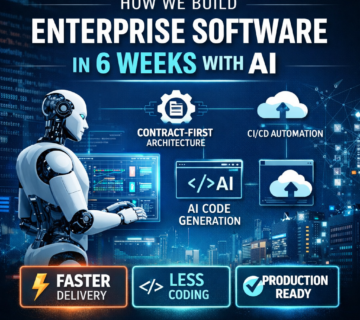
Modern AI systems can generate production-ready code from natural language descriptions. Developers describe what they need—”create a user authentication system with two-factor verification and password recovery”—and AI tools produce the necessary code framework, complete with security best practices and error handling.
This capability extends beyond simple functions. AI can generate complex database schemas, API endpoints, user interface components, and integration layers. The technology analyzes millions of code repositories to understand patterns, best practices, and optimal implementations for specific use cases.
What previously required days of manual coding now takes hours. Development teams focus on architecture decisions, business logic refinement, and creative problem-solving while AI handles the foundational coding work. This acceleration doesn’t compromise quality—AI-generated code often adheres more consistently to coding standards than manually written code because the AI applies learned best practices uniformly.
Intelligent Testing Automation
Testing represents one of the most time-consuming aspects of traditional software development. AI transforms this process through intelligent test generation, automated regression testing, and predictive quality assurance.
AI testing systems automatically create comprehensive test suites by analyzing code functionality. They identify edge cases that human testers might overlook, generate test data that represents realistic usage scenarios, and continuously execute tests as code changes. When bugs appear, AI tools often pinpoint the exact code causing issues and sometimes suggest corrections.
More impressively, AI can predict where bugs are likely to occur before they happen. By analyzing code complexity, change patterns, and historical defect data, machine learning models identify high-risk code sections that need extra testing attention. This predictive capability prevents issues rather than just detecting them after they occur.
Predictive Design and Architecture
AI doesn’t just write code—it helps architect entire systems. Advanced AI platforms analyze business requirements, user behavior patterns, and technical constraints to recommend optimal application architectures.
These systems consider factors like scalability requirements, expected user loads, data processing needs, integration points, and budget constraints. They propose architecture patterns that have proven successful for similar projects, suggest appropriate technologies and frameworks, and identify potential bottlenecks before development begins.
Predictive design also extends to user experience. AI analyzes user interaction data to recommend interface layouts, navigation structures, and feature placements that maximize engagement and usability. This data-driven approach to design replaces guesswork with proven patterns validated across thousands of applications.
What Are the Business Benefits of AI App Development Services?
Reduced Development Time and Costs
Time equals money in software development. Traditional enterprise applications often require 12-18 months from concept to deployment. AI-driven software development compresses this timeline to 4-8 months for comparable projects.
This acceleration comes from multiple sources: automated code generation, parallel development streams, reduced testing cycles, and fewer post-deployment fixes. Businesses launch products faster, respond to market changes more quickly, and iterate based on user feedback without lengthy development delays.
Cost savings extend beyond shorter timelines. Companies need smaller development teams because AI handles routine coding tasks. Infrastructure costs decrease because AI-optimized code runs more efficiently. Maintenance expenses drop because AI-generated code has fewer bugs and follows consistent patterns that simplify updates.
Improved Application Quality and Reliability
AI excels at consistency and pattern recognition—two critical factors in software quality. Applications built with AI assistance typically have fewer bugs, more consistent code quality, and better adherence to security standards.
Machine learning models trained on millions of code examples recognize anti-patterns and potential vulnerabilities that individual developers might miss. They enforce coding standards automatically, ensuring every team member’s contributions meet the same quality bar. This consistency becomes particularly valuable as projects scale and multiple developers contribute code.
Security represents another quality dimension where AI delivers measurable improvements. AI tools identify common vulnerabilities like SQL injection points, cross-site scripting risks, and insecure data handling. They recommend—and often implement—security best practices as code is generated, building protection into applications from the foundation rather than adding it later.
Scalability and Future-Proofing
Applications built with AI-driven development inherently support better scalability. AI systems design with growth in mind, creating architectures that accommodate increased users, data volume, and feature complexity without major rewrites.
This forward-looking approach considers how applications will evolve. AI analyzes industry trends, emerging technologies, and your business trajectory to recommend architectural decisions that remain valid as requirements change. The result is applications that adapt rather than becoming technical debt requiring expensive overhauls.
How Are U.S. Companies Using AI Automation Tools for Business?
Enterprise Resource Planning Enhancement
Major corporations are leveraging AI development to modernize legacy ERP systems without complete replacement. AI tools create intelligent middleware that connects outdated systems with modern interfaces, adds predictive analytics to traditional reporting, and automates workflows that previously required manual intervention.
These enhancements extend ERP system life while adding capabilities that would be impossible through traditional customization. Companies preserve existing data and processes while gaining AI-powered insights, automated decision-making, and integration with newer business systems.
Customer Experience Applications
Retail, healthcare, financial services, and hospitality industries are deploying AI-built customer applications that personalize experiences at scale. These applications analyze individual customer behavior, predict needs, recommend relevant products or services, and adapt interfaces based on user preferences.
Unlike template-based applications, AI-driven customer platforms continuously learn and improve. They identify which features drive engagement, which workflows cause friction, and which communication approaches resonate with different customer segments. This continuous optimization happens automatically without ongoing development resources.
Internal Operations and Workflow Automation
Forward-thinking businesses are using AI app development services to create custom internal tools that streamline operations. From automated inventory management systems to intelligent scheduling platforms, these applications handle complex business logic that previously required manual decision-making.
The advantage of AI-driven development for internal tools is rapid customization. As business processes evolve, AI can quickly modify applications to reflect new workflows, integrate additional data sources, or add functionality. This agility prevents the common scenario where internal systems become obstacles to process improvement because modification is too expensive or time-consuming.
Data Analytics and Business Intelligence Platforms
Companies are building sophisticated analytics platforms using AI development tools that process massive datasets, identify meaningful patterns, and present insights through intuitive dashboards. These systems go beyond traditional reporting by predicting trends, recommending actions, and automating routine analysis tasks.
AI-built analytics platforms adapt to changing business questions. As leadership needs different insights or new data sources become available, the systems evolve without requiring extensive redevelopment. This flexibility ensures analytics investments deliver value long-term rather than becoming obsolete as business intelligence needs change.
What Should Businesses Consider When Adopting AI-Driven Development?
Integration with Existing Systems
Successful AI-driven software development requires careful consideration of current technology infrastructure. AI tools must integrate with existing databases, APIs, authentication systems, and business processes. This integration complexity varies based on legacy system architecture and data accessibility.
Experienced IT support teams understand integration challenges and can architect solutions that bridge AI-generated applications with established systems. Proper planning prevents scenarios where new AI-built applications remain isolated from critical business data or processes.
Data Quality and Availability
AI development tools perform optimally when they have access to quality data. Applications that personalize experiences, predict outcomes, or automate decisions require training data that accurately represents business scenarios.
Organizations should audit their data before committing to AI development projects. Clean, well-organized data accelerates development and improves AI model accuracy. Poor data quality leads to applications that make incorrect predictions or require extensive manual correction—undermining the efficiency gains AI promises.
Security and Compliance Considerations
AI-generated code must meet the same security standards as human-written software. While AI tools incorporate security best practices, organizations remain responsible for validating that applications protect sensitive data, maintain compliance with regulations, and implement appropriate access controls.
This responsibility intensifies for industries with strict compliance requirements like healthcare, finance, or legal services. Cybersecurity services should review AI-developed applications to ensure they meet industry-specific security standards and regulatory requirements before deployment.
Vendor Selection and Partnership
Not all AI development platforms deliver equivalent results. Capabilities vary significantly between providers regarding code quality, supported programming languages, integration options, and ongoing support.
Businesses should evaluate AI development partners based on industry experience, technical expertise, security practices, and post-deployment support. The right partnership extends beyond initial development to include optimization, scaling, and continuous improvement as business needs evolve.
Frequently Asked Questions About AI-Driven Software Development
How much faster is AI-driven development compared to traditional methods?
AI-driven software development typically reduces project timelines by 40-60% compared to traditional development approaches. Simple applications that previously required three months might be completed in four to six weeks. Enterprise-scale projects that traditionally take 18 months can often be delivered in 8-10 months. The exact acceleration depends on project complexity, integration requirements, and how extensively AI tools are utilized throughout the development lifecycle.
Does AI-generated code require human oversight?
Yes, human oversight remains essential for AI-driven development. While AI handles significant coding tasks, experienced developers review AI-generated code for accuracy, optimize for specific business requirements, and make architectural decisions AI cannot make independently. Think of AI as a highly capable assistant that accelerates development rather than a complete replacement for human expertise. The most successful projects combine AI efficiency with human creativity and business understanding.
What types of applications are best suited for AI development?
AI-driven development excels with data-intensive applications, customer-facing platforms, workflow automation systems, and business intelligence tools. Applications requiring personalization, predictive analytics, or processing large datasets particularly benefit from AI approaches. Less ideal candidates include applications with highly specialized regulatory requirements, systems requiring extensive custom hardware integration, or projects where AI tools lack relevant training data for the specific use case.
Can existing applications be enhanced with AI capabilities?
Absolutely. One of the most practical applications of AI-driven development involves enhancing existing applications rather than building from scratch. AI tools can add predictive features to legacy systems, create intelligent interfaces for older applications, automate manual processes within current workflows, and integrate modern capabilities without complete system replacement. This approach often delivers faster ROI than greenfield AI development projects.
What programming languages do AI development tools support?
Modern AI development platforms support all major programming languages including Python, JavaScript, Java, C#, Ruby, PHP, and Go. Some platforms specialize in specific languages while others offer broad support. The choice often depends on existing technology infrastructure and specific project requirements. Most enterprise-focused AI development services work across multiple languages to ensure compatibility with current systems.
How do you ensure AI-generated code is secure?
Security in AI-generated code comes through multiple layers. AI systems trained on secure coding practices automatically implement security standards like input validation, proper authentication, encrypted data transmission, and secure session management. Additionally, automated security scanning tools analyze AI-generated code for vulnerabilities, and human security experts conduct reviews before deployment. Regular updates keep AI models current with emerging security threats and best practices.
What is the ROI timeline for AI development projects?
Most businesses see positive ROI within 6-12 months of deploying AI-developed applications. Faster development reduces upfront costs, operational automation delivers immediate savings, and improved efficiency compounds over time. Applications that enhance customer experience or enable new revenue streams often show returns even faster. The specific timeline depends on project scope, implementation complexity, and how effectively the application addresses business challenges.
Do we need to completely change our development process?
No, AI-driven development integrates with existing development methodologies. Whether your team uses Agile, DevOps, or traditional waterfall approaches, AI tools augment rather than replace current processes. Many organizations start with pilot projects using AI for specific development tasks before expanding to broader adoption. This gradual approach allows teams to build expertise while minimizing disruption to established workflows.
How Technijian Can Help
Technijian brings over two decades of technology expertise to businesses seeking to leverage AI-driven software development. Our team understands that successful AI implementation requires more than just access to development tools—it demands strategic planning, technical excellence, and ongoing support that aligns technology with business objectives.
Comprehensive AI Development Strategy
We begin every engagement by understanding your business challenges, growth objectives, and current technology landscape. Our consultants work with your leadership team to identify applications where AI-driven development delivers maximum impact, whether that’s customer-facing platforms, operational efficiency tools, or data analytics systems.
This strategic foundation ensures AI investments support business goals rather than becoming technology for technology’s sake. We help prioritize projects based on potential ROI, implementation complexity, and strategic importance, creating a roadmap that delivers value progressively rather than requiring massive upfront commitments.
Expert Implementation and Integration
Our development team possesses deep expertise in AI-driven development platforms combined with practical experience integrating AI-generated applications with existing business systems. We handle the technical complexities of connecting new AI-built applications to legacy databases, authentication systems, APIs, and business processes.
This integration expertise prevents common pitfalls where AI development projects create isolated applications that don’t effectively serve business needs. Our approach ensures new applications work seamlessly within your technology ecosystem, accessing necessary data and supporting established workflows while adding intelligent capabilities that weren’t previously possible.
Security-First Development Approach
Every application we develop undergoes rigorous security review regardless of whether AI or human developers write the code. Our cybersecurity team validates that AI-generated code implements proper authentication, protects sensitive data, prevents common vulnerabilities, and meets industry-specific compliance requirements.
For businesses in regulated industries, we ensure AI-developed applications satisfy requirements like HIPAA for healthcare, PCI DSS for payment processing, or SOC 2 for service providers. This security validation happens throughout development rather than as an afterthought, building protection into application foundations.
Ongoing Optimization and Support
AI-driven applications improve over time through continuous learning and optimization. Technijian provides ongoing support that monitors application performance, analyzes user behavior, identifies optimization opportunities, and implements enhancements that improve functionality and efficiency.
This sustained partnership ensures your AI investments deliver increasing value rather than becoming static systems requiring eventual replacement. As your business evolves, we adapt applications to support new requirements, integrate emerging technologies, and maintain competitive advantages that AI-driven development provides.
Orange County Expertise with National Reach
Based in Irvine, California, Technijian serves businesses throughout Orange County and across the United States. Our local presence enables responsive support for Southern California companies while our remote capabilities extend comprehensive AI development services to organizations nationwide.
We understand the unique challenges facing businesses in competitive markets where innovation drives success. Whether you’re a growing startup needing to build sophisticated applications quickly or an established enterprise modernizing legacy systems, our team delivers AI-driven development solutions scaled to your specific situation and objectives.
Ready to Build Smarter Applications?
AI-driven software development isn’t future technology—it’s the competitive advantage businesses are leveraging today. Companies that adopt AI development now gain faster time-to-market, reduced costs, improved application quality, and capabilities that manual development approaches cannot match.
The question isn’t whether AI will transform software development—it’s whether your business will lead or follow this transformation.
Request a free AI development consultation with Technijian today. Our team will evaluate your current development challenges, identify opportunities where AI delivers measurable improvements, and create a practical roadmap for implementing AI-driven development that aligns with your business objectives.
Contact us at (949) 379-8499 or visit our AI-Driven Development services page to schedule your consultation. Discover how the same AI technologies powering Fortune 500 innovation can accelerate your application development, reduce costs, and deliver sophisticated software that drives business growth.
About Technijian: Since 2000, Technijian has delivered comprehensive technology solutions to businesses throughout Orange County and Southern California. Our expertise spans managed IT services, cybersecurity, cloud computing, and AI-driven development, helping organizations leverage technology for competitive advantage. Learn more at technijian.com or call (949) 379-8499