How to Build an Enterprise AI Strategy Roadmap That Actually Delivers: A 4-Phase Framework
🎙️ Dive Deeper with Our Podcast!
Your board has mandated an AI strategy. Your CEO wants measurable results within two quarters. Your competitors just launched AI-powered features that your customers are asking about. And your organization has a handful of disconnected AI experiments running in different departments with no unified direction, no governance framework, and no connection to measurable business outcomes.
You are not alone. According to MIT’s 2025 GenAI Divide report, 95% of enterprise generative AI projects fail to move beyond the experimental phase. PwC’s 2026 Global CEO Survey found that 56% of CEOs report getting “nothing” from their AI adoption efforts. And 42% of companies abandoned most of their AI initiatives in 2025—up dramatically from the previous year.
The organizations that succeed share one characteristic: they have a structured, phased AI strategy roadmap that connects every AI investment to measurable business outcomes, establishes governance before deployment, and builds organizational capability alongside technology. This guide provides that roadmap—built specifically for the CIOs, DX directors, and innovation leaders across Orange County and Los Angeles who need to deliver AI value, not AI experiments.
| Target keywords: enterprise AI strategy consulting Orange County • enterprise AI transformation roadmap Los Angeles • AI business process automation Irvine CA • AI vendor selection consultant Southern California • AI proof of concept development downtown LA |
Why Most Enterprise AI Strategies Fail
Before building a roadmap that works, it helps to understand why the majority of AI strategies fail. The failure patterns are consistent and predictable:
| 95% | Of enterprise GenAI pilots fail to reach production—the problem is not the technology, it is the approach |
| 56% | Of CEOs report getting “nothing” from their AI adoption efforts (PwC 2026 Global CEO Survey) |
| 70–85% | Of all AI projects fail to meet expected outcomes—the highest failure rate of any enterprise technology category |
| 46% | Of AI proofs of concept are scrapped before reaching production—nearly half of experiments never deliver value |
| 34% | Of enterprises say their AI programs produce measurable financial impact—leaving two-thirds without demonstrable returns |
| 40% | Of enterprise apps will feature task-specific AI agents by end of 2026 (Gartner)—the transformation is accelerating |
The five most common failure modes:
- Technology-first, problem-second: Organizations select AI tools based on vendor hype or competitive pressure, then search for problems to solve. The 5% that succeed start with business problems and select tools that address them.
- Pilot purgatory: Promising experiments never transition to production because there is no governance framework, no deployment infrastructure, and no organizational readiness for AI-powered workflows.
- Fragmented initiatives: Different departments run independent AI projects with separate budgets, different tools, and no shared learning. The compounding effect that drives AI ROI—where each deployment makes the next cheaper and faster—never materializes.
- Missing change management: AI tools are deployed without redesigning the workflows they support or training the employees who use them. Productivity gains of 10–15% typically materialize only after formal job redesign and structured enablement.
- No measurement infrastructure: Organizations deploy AI without establishing baseline metrics, defining success criteria, or building the dashboards that connect AI performance to business outcomes. Without measurement, there is no accountability and no evidence for continued investment.
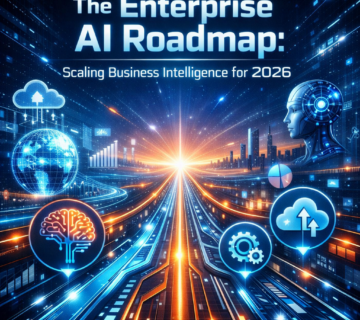
The 4-Phase Enterprise AI Strategy Roadmap
This roadmap is built on how organizations are actually succeeding with AI in 2026—not on theoretical frameworks or vendor sales presentations. Each phase has a clear objective, specific deliverables, a realistic timeline, and the failure mode it prevents.
Phase 1: Strategic Alignment and Readiness Assessment (Weeks 1–6)
Objective: Define why you are investing in AI, assess whether your organization is ready, and identify the 2–3 highest-ROI use cases before touching any technology.
This phase prevents the most expensive failure mode in enterprise AI: buying the solution before defining the problem. Every dollar spent here saves five to ten dollars in wasted development during later phases.
Key activities:
- Executive alignment workshop: Define the specific business outcomes AI must deliver—revenue growth, cost reduction, customer experience improvement, operational efficiency, or competitive differentiation—with measurable KPIs for each.
- Data readiness audit: Assess the quality, accessibility, and governance of the data your AI initiatives will require. Only 26% of Chief Data Officers are confident their data can actually support AI-driven outcomes. Data problems discovered mid-implementation add 3–6 months to timelines.
- Use case prioritization: Score potential AI initiatives across five dimensions: business value, data readiness, technical feasibility, resource requirements, and time to value. Select 2–3 initiatives that score highest across all dimensions.
- Governance framework design: Establish AI ethics policies, acceptable use guidelines, compliance mapping (HIPAA, SOC 2, CCPA, FINRA as applicable), and accountability roles before any deployment begins.
Deliverables: AI strategy document, prioritized use-case portfolio, data readiness report, governance framework, and executive-approved roadmap with milestones and budget.
| Failure mode this phase prevents: Organizations that skip strategic alignment waste 6–12 months and $500K+ on AI experiments that never connect to business outcomes. This phase costs $25K–$75K and takes 4–6 weeks. The ROI of getting it right is immeasurable. |
Phase 2: Proof of Concept and Validation (Weeks 6–12)
Objective: Validate that your highest-priority AI use case delivers measurable value on your actual business data before committing to full-scale deployment.
This phase prevents pilot purgatory by requiring production-grade evidence of value—not demo-grade excitement—before scaling investment.
Key activities:
- Rapid POC development: Build a working proof of concept for your top-priority use case within 2—4 weeks. Use your actual business data, not sample datasets. The POC must demonstrate measurable impact on the KPIs defined in Phase 1.
- Baseline measurement: Document pre-POC metrics for the targeted process: current cost, time, error rate, throughput, and any other KPIs defined during strategic alignment.
- Security and compliance validation: Verify that the POC meets your governance requirements: data does not leak to unauthorized systems, access controls function correctly, and audit logging captures all AI interactions.
- Stakeholder validation: Present POC results to executive sponsors with quantified impact. The go/no-go decision for Phase 3 is based on measured results, not enthusiasm.
Deliverables: Working POC, baseline vs. post-POC measurement comparison, security validation report, and executive recommendation for Phase 3 investment.
| Technijian delivers AI proofs of concept within two weeks—using your actual business data and real use cases. This rapid validation allows your leadership team to evaluate AI’s impact before committing to full-scale deployment, dramatically reducing the 46% POC failure rate. |
Phase 3: Production Deployment and Integration (Weeks 12–24)
Objective: Deploy the validated AI solution into production, integrate it with existing systems, redesign affected workflows, and train the employees who will use it daily.
This phase prevents the change management failures that cause technically successful AI deployments to produce no measurable business impact.
Key activities:
- Production-grade architecture: Build the deployment infrastructure with enterprise security controls: SSO integration, role-based access, data encryption, audit logging, monitoring, and alerting.
- System integration: Connect the AI solution to your existing technology stack—CRM, ERP, data warehouse, communication platforms—through secure APIs with proper authentication and error handling.
- Workflow redesign: Redesign the business processes the AI solution affects. AI tools deployed without workflow redesign consistently underperform. This is the step most organizations skip—and it is the step that determines whether productivity gains materialize.
- Employee training and enablement: Train affected employees on the new AI-augmented workflows. Effective training programs require dozens of hours per employee and include hands-on practice, not just presentations.
- Continuous measurement: Track production KPIs against the baselines established in Phase 2. Report results to executive sponsors monthly with actionable insights on optimization opportunities.
Deliverables: Production deployment, integration documentation, redesigned workflow documentation, training completion records, and monthly KPI dashboards.
Phase 4: Scaling, Optimization, and Next-Horizon Planning (Month 6+)
Objective: Expand AI across additional use cases, optimize existing deployments for maximum ROI, and prepare for agentic AI capabilities that will define the next wave of enterprise value.
This phase captures the compounding effect that separates AI leaders from laggards. Each successful deployment makes the next 40–70% cheaper because governance frameworks, data pipelines, integration patterns, and organizational capabilities are already established.
Key activities:
- Expand to additional use cases: Deploy validated AI solutions to the next 2–3 highest-priority use cases from the Phase 1 portfolio. Each deployment leverages the infrastructure, governance, and organizational learning from previous deployments.
- Optimize existing deployments: Analyze production performance data to identify optimization opportunities: model retraining, workflow adjustments, feature additions, and cost reduction through infrastructure right-sizing.
- Multi-platform governance: As your enterprise uses multiple AI platforms (Copilot, Gemini, ChatGPT, custom solutions), establish unified governance that ensures consistent security, compliance, and usage policies across all tools.
- Agentic AI preparation: Gartner projects that 40% of enterprise applications will have embedded AI agents by the end of 2026. Begin planning for autonomous AI systems with human-in-the-loop controls, strict permission boundaries, and escalation protocols.
- Quarterly ROI reporting: Provide board-ready quarterly reports that quantify AI’s cumulative impact on the business outcomes defined in Phase 1.
| The compounding effect is real and measurable. Each AI deployment makes the next one 40–70% cheaper because governance frameworks, data pipelines, and organizational capabilities are already in place. The enterprises building AI infrastructure now are buying down the cost of every future deployment. |
How Technijian Builds and Executes Enterprise AI Roadmaps
Technijian’s AI consulting practice provides end-to-end roadmap design and execution for enterprises across Orange County and Los Angeles. Our approach is built on vendor neutrality, measurable outcomes, and the Secure AI Implementation principle that ensures every deployment is safe, compliant, and accountable.
| Secure AI Implementation | How This Delivers Your AI Roadmap |
| AI Readiness Assessment | We evaluate your data infrastructure, technology stack, organizational readiness, and competitive landscape—then identify the 2–3 highest-ROI AI opportunities with projected financial impact for each. |
| Vendor-Neutral Platform Advisory | We recommend AI platforms based exclusively on your requirements—not our vendor partnerships. Copilot, Gemini, ChatGPT, or custom solutions: the right tool depends on your stack, your data, and your compliance requirements. |
| AI Proof of Concept in 2 Weeks | Working POCs on your actual business data within fourteen days. See real results before committing budget—dramatically reducing the 46% failure rate of traditional POC approaches. |
| Production Deployment & Integration | End-to-end implementation including security architecture, system integration, workflow redesign, employee training, and compliance documentation—delivered by engineers who understand enterprise constraints. |
| AI Governance Framework | Comprehensive governance covering AI ethics, acceptable use, compliance mapping, audit trails, vendor management, and accountability roles—designed for your specific regulatory environment. |
| Ongoing AI Operations & Optimization | Post-deployment managed operations including performance monitoring, model optimization, security patching, and quarterly ROI reporting—ensuring your AI investments continue delivering value long after launch. |
| “The organizations in the 5% that succeed with AI are not the ones with the biggest budgets or the most advanced technology. They are the ones that start with business problems, validate with real data, deploy with governance, and measure relentlessly. That is exactly the roadmap we build and execute for every client.” — Technijian AI Consulting |
Frequently Asked Questions
Q: How long does it take to build an enterprise AI strategy roadmap?
A: A comprehensive AI strategy roadmap typically requires 4–6 weeks for the assessment and planning phase (Phase 1), followed by 6–8 weeks for proof of concept validation (Phase 2). The full four-phase roadmap spans 12–24 months from initial assessment to scaled deployment. Technijian’s structured approach compresses the planning phase to 2–4 weeks through proven frameworks and accelerated discovery.
Q: How much does an enterprise AI roadmap cost?
A: Phase 1 (assessment and strategy) typically costs $25,000–$75,000. Phase 2 (POC) ranges from $15,000–$50,000. Full production deployment (Phase 3) ranges from $100,000–$500,000+ depending on complexity. The total investment is a fraction of the cost of failed AI experiments—which average $500,000+ in wasted spend for enterprises that skip strategic planning.
Q: Why do 95% of AI pilots fail to reach production?
A: The five most common failure modes are: starting with technology instead of business problems, running disconnected pilots with no governance framework, skipping data readiness assessment, deploying AI without workflow redesign or employee training, and failing to establish measurement infrastructure that connects AI performance to business outcomes. A structured roadmap addresses all five.
Q: Should my enterprise standardize on one AI platform or use multiple?
A: Most enterprises will use multiple AI platforms—over 80% of large enterprises already run three or more AI model families concurrently. The key is establishing unified governance that ensures consistent security, compliance, and usage policies across all platforms. Technijian’s vendor-neutral approach helps you select the right platform for each use case and govern the resulting multi-platform environment.
Q: What is agentic AI and should my roadmap include it?
A: Agentic AI refers to autonomous systems that can reason, plan, and execute multi-step tasks without human intervention. Gartner projects 40% of enterprise apps will feature AI agents by end of 2026. Your roadmap should include agentic AI preparation even if you are not ready to deploy agents today—the governance and infrastructure decisions you make now determine whether future agent deployments succeed or create liability.
Q: How do I convince my board to fund an AI strategy?
A: Present AI investment using the same framework your board uses for capital expenditure decisions: identify specific business problems, quantify current costs, project expected savings or revenue impact, define measurable milestones, and propose a phased approach that validates value before scaling. Technijian’s readiness assessment produces board-ready business cases as a standard deliverable.
Q: What governance framework does Technijian recommend?
A: We build governance frameworks tailored to each client’s regulatory environment, covering AI ethics policies, acceptable use guidelines, compliance mapping (HIPAA, SOC 2, CCPA, FINRA, EU AI Act as applicable), data classification for AI interactions, vendor risk management, audit trail requirements, and human-in-the-loop protocols for autonomous systems.
Q: Can mid-market companies ($50M–$500M revenue) benefit from an AI roadmap?
A: Absolutely. Mid-market enterprises often see the highest ROI from structured AI roadmaps because they have enough operational complexity to benefit from AI but enough organizational agility to implement changes quickly. Our roadmap framework scales to organizations of all sizes—the phases remain the same; the scope and investment scale with organizational complexity.
Q: What areas does Technijian serve for AI strategy consulting?
A: We serve enterprises across Orange County (Irvine 92618, Newport Beach, Costa Mesa), Los Angeles (Downtown LA 90017, Torrance 90503, Culver City 90230), and the broader Southern California region. Our AI consulting engagements also support national enterprises with California-based operations.
Q: How do I get started with an AI strategy roadmap?
A: Contact Technijian at (949) 379-8500 or visit technijian.com to schedule a complimentary AI readiness consultation. We will assess your current AI maturity, identify your highest-priority opportunities, and outline a phased roadmap with clear timelines, investment requirements, and expected business outcomes—typically within one week.
Be in the 5% That Succeeds with Enterprise AI
Get a complimentary AI Readiness Consultation from Technijian. We’ll assess your maturity, identify your highest-ROI opportunities, and outline a roadmap that delivers measurable business outcomes.
Related Topics:
Microsoft Copilot implementation Orange County • Google Gemini integration services Irvine • ChatGPT Enterprise consulting Southern California • AI business process automation Irvine CA • LLM integration for enterprises Orange County • AI data analytics consultant Irvine Business Park • Power BI AI integration Orange County • AI penetration testing HackGPT Irvine • enterprise AI strategy consulting Orange County • AI vendor selection consultant Southern California • enterprise AI transformation roadmap Los Angeles • AI ROI calculator for enterprises LA • Microsoft AI partner Los Angeles financial district • AI proof of concept development downtown LA • generative AI consulting Fortune 500 Los Angeles