Your SEO Guy Can’t Rank You in ChatGPT: Why AI Search Optimization is the Future
🎙️ Dive Deeper with Our Podcast!
Summary
The rules of online visibility have changed. For years, businesses relied on traditional SEO professionals to boost their Google rankings through keyword stuffing, backlink schemes, and meta tag tweaks. But here is the uncomfortable truth: the way people search for information is shifting fast. Millions of users now turn to AI-powered platforms like ChatGPT, Google Gemini, and Perplexity to get answers instead of scrolling through ten blue links. Your conventional SEO provider was never trained for this reality. This blog explores why your current SEO strategy is falling behind, why AI search engines demand a completely different approach, and how Technijian bridges the gap with forward-thinking SEO services designed for both traditional search and the new era of AI-driven discovery.
The Search Landscape Has Shifted Under Your Feet
Think about the last time you looked something up online. Did you type a query into Google and click through five different websites? Or did you open ChatGPT and ask a direct question, getting a clear, conversational answer in seconds? You are not alone if the latter is your response. A growing percentage of internet users now prefer AI-powered search tools because they cut through the noise and deliver precisely what people are looking for.
Traditional search engines like Google still matter, of course. They handle billions of queries every day. But the emergence of conversational AI platforms has created an entirely new battlefield for online visibility. Businesses that ignore this shift risk becoming invisible to a rapidly growing audience segment that may never visit a traditional search results page at all.
Your SEO provider probably understands how to optimize a webpage for Google. They know about title tags, header structures, internal linking, and domain authority. What they likely do not understand is how large language models decide which businesses to mention, recommend, or cite when a user asks a question. These are two fundamentally different systems, and mastering one does not guarantee success in the other.
What Traditional SEO Actually Does (And Where It Stops)
Before diving deeper into what is missing, it helps to acknowledge what conventional SEO does well. A skilled SEO professional can improve your website’s technical health, ensure your pages load quickly, fix crawl errors, and structure your content so that search engine bots can index it efficiently. They can research keywords, build backlinks, and help you climb the rankings for specific search terms.
All of that remains valuable. Nobody is arguing that Google optimization is dead. The problem is that traditional SEO operates within a very specific framework: get a webpage to appear on the first page of a search engine results page. The entire discipline was built around this goal.
AI search platforms operate on a completely different model. When someone asks ChatGPT a question like “What is the best IT support company in Orange County?” the system does not crawl your website in real time and check your meta descriptions. It draws on patterns in its training data, references from authoritative sources, and the overall reputation your brand has built across the digital landscape. There is no first page to rank on. There are no ten blue links. There is only the answer that the AI chooses to provide.
Why AI Search Engines Think Differently Than Google
Understanding the difference between Google’s algorithm and an AI language model’s response generation is crucial for any business that wants to stay competitive.
Google’s algorithm evaluates webpages based on hundreds of ranking factors. It looks at on-page content, technical performance, backlink profiles, user engagement signals, and much more. The output is a ranked list of webpages, and your goal is to appear as high on that list as possible.
AI language models like ChatGPT work differently. They synthesize information from vast datasets to generate conversational responses. They do not rank websites. Instead, they recommend, mention, or describe businesses based on the cumulative digital footprint those businesses have created. Brand mentions across trusted publications, consistent information across directories, thought leadership content, positive review sentiment, and authoritative references all influence whether an AI platform will name your business in a response.
This means that even if your website sits at position one on Google for your target keyword, ChatGPT might never mention your company. Conversely, a business with a strong, well-distributed online presence might get recommended by AI platforms even if their Google rankings are mediocre. The playing field is different, and the strategies that win are different too.
The Gap Your Current SEO Provider Cannot Fill
Most SEO agencies and freelancers have spent years perfecting their craft within the Google ecosystem. They attend conferences about algorithm updates. They study Core Web Vitals. They track keyword positions obsessively. And within that context, many of them do excellent work.
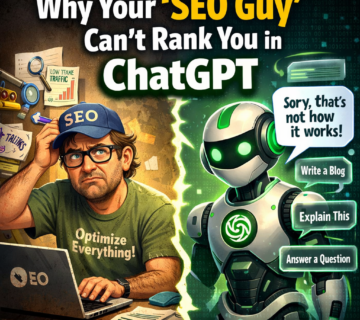
If you inquire about your SEO provider’s strategy for getting your company featured in ChatGPT answers, you’ll probably receive a blank stare or a hazy statement about “content quality.” That is because AI search optimization is not something most SEO professionals have studied, practiced, or even considered as part of their service offering.
Optimizing for AI discovery requires a different skill set. It demands an understanding of how language models process and prioritize information, how brand authority is measured outside the context of backlinks, and how to create a digital presence that AI systems recognize as trustworthy and relevant. It requires strategies around entity optimization, structured data at scale, brand sentiment management, and content distribution across platforms that AI models are known to reference.
This is not a criticism of traditional SEO providers. It is simply an acknowledgment that the industry has evolved faster than most practitioners have adapted. And businesses that wait for their current providers to catch up may find themselves losing ground to competitors who moved first.
What AI Search Optimization Actually Looks Like
So what does it take to show up in AI-generated answers? The approach is multifaceted and goes well beyond anything a standard SEO checklist covers.
- Brand entity building is the foundation. AI models need to understand what your business is, what it does, and why it matters. This means ensuring your brand is consistently represented across the web with accurate, structured information. Your business name, services, location, and expertise should appear in directories, industry publications, news outlets, and knowledge bases that AI systems draw from.
- Content authority plays a major role. AI platforms favor information from sources that demonstrate genuine expertise. Thin blog posts stuffed with keywords will not cut it. Instead, businesses need comprehensive, well-researched content that answers real questions thoroughly and positions the brand as a credible authority in its field.
- Reputation signals matter more than ever. AI models consider the overall sentiment surrounding a brand. Positive reviews, testimonials, case studies, and mentions in trusted publications all contribute to the likelihood that an AI platform will recommend your business. Negative sentiment or a lack of online reviews can push you out of the conversation entirely.
- Structured data and schema markup help AI systems interpret your content accurately. While schema has always been part of technical SEO, its importance grows exponentially in the AI context because language models rely on structured information to understand relationships between entities, services, and locations.
- Cross-platform presence ensures your brand appears in the diverse range of sources that AI models reference. This includes social media profiles, industry forums, podcast appearances, video content, guest articles, and more. A business that only exists on its own website and a Google Business Profile is far less likely to be recognized by AI platforms than one with a rich, distributed digital presence.
The Real Cost of Ignoring AI Search
Every month that passes without an AI search strategy is a month where your competitors have the opportunity to establish themselves as the go-to recommendation in AI-generated responses. Once an AI model associates a particular brand with a specific service or industry, it becomes significantly harder for competitors to displace that association.
Think of it like this: Google rankings fluctuate constantly. You might rank third today and seventh tomorrow. AI recommendations, while not static, tend to be stickier. When a language model consistently encounters strong signals for a particular brand, it builds a pattern of association that influences future responses. Early movers in AI search optimization have a compounding advantage.
The financial implications are real. If a potential customer asks ChatGPT for an IT services recommendation and your competitor gets mentioned while you do not, that is a lost opportunity you may never even know about. There is no analytics dashboard showing you the ChatGPT queries where your business was absent. The leads simply go elsewhere, and you are left wondering why your pipeline feels thinner despite steady Google rankings.
Why a Combined Approach Is the Only Smart Strategy
To be clear, nobody should abandon traditional SEO in favor of AI search optimization alone. Both channels drive real business results, and the smartest approach integrates both into a unified strategy.
Traditional SEO continues to capture intent-driven traffic from people who are actively searching for solutions. AI search optimization captures a newer, growing audience that prefers conversational discovery. Together, they create a comprehensive visibility strategy that covers every way a potential customer might find your business.
The challenge is finding a partner who understands both worlds deeply enough to execute effectively across both. Most SEO agencies are still firmly rooted in the traditional playbook, and most AI-focused consultants lack the technical SEO expertise needed to maintain strong Google performance. What businesses need is a team that operates fluently in both spaces.
Frequently Asked Questions
Q: Can my regular SEO agency also handle AI search optimization?
A: Most traditional SEO agencies do not offer AI search optimization because it requires a fundamentally different skill set. While your current provider may do great work on Google rankings, getting your brand recommended by ChatGPT and similar platforms demands expertise in entity optimization, brand authority building, and understanding how language models select and present information. It is a specialized discipline that few agencies have adopted so far.
Q: Is AI search optimization replacing traditional SEO?
A: No. Traditional SEO remains critically important for capturing search engine traffic. AI search optimization is an additional layer of visibility that addresses the growing number of users who rely on AI platforms for information and recommendations. The best results come from a combined strategy that covers both traditional and AI-driven search channels.
Q: How does ChatGPT decide which businesses to recommend?
A: ChatGPT and similar AI models generate recommendations based on patterns in their training data and referenced sources. They consider factors like brand authority, consistency of information across the web, sentiment from reviews and mentions, content depth and expertise, and structured data. Unlike Google, there is no simple ranking list. The AI synthesizes multiple signals to determine which businesses to mention in its responses.
Q: How long does it take to see results from AI search optimization?
A: AI search optimization is a long-term strategy. Building the kind of brand authority and digital presence that AI models recognize takes consistent effort over several months. However, early action provides a significant advantage because AI associations tend to compound over time. Businesses that start now will be much harder for competitors to displace later.
Q: What industries benefit most from AI search optimization?
A: Every industry that relies on online visibility benefits from AI search optimization. However, service-based businesses like IT support, legal firms, healthcare providers, marketing agencies, and consulting companies see particularly strong returns because AI users frequently ask for recommendations in these categories.
Q: Does Technijian only focus on ChatGPT, or other AI platforms too?
A: Technijian’s AI search optimization strategy covers the full spectrum of AI-powered platforms, including ChatGPT, Google Gemini, Perplexity, Microsoft Copilot, and other emerging AI search tools. The goal is to build a brand presence that is recognized and recommended across all AI discovery channels, not just one.
Q: Will AI search optimization hurt my current Google rankings?
A: Absolutely not. In fact, many of the strategies involved in AI search optimization — such as building brand authority, creating high-quality content, and improving structured data — also strengthen your traditional SEO performance. With Technijian, your Google rankings are maintained and improved alongside your AI visibility.
How Technijian Can Help
Technijian is not just another SEO company recycling the same tired playbook from 2015. The team at Technijian recognized early that the search landscape was heading toward a fundamental transformation, and they built their service offering to meet that future head-on.
When you partner with Technijian for SEO services, you get a team that operates across both traditional search engine optimization and AI search optimization. They start by auditing your current digital presence to identify gaps in both Google visibility and AI discoverability. From there, they build a customized strategy that strengthens your brand across every channel that matters.
On the traditional SEO side, Technijian handles everything from technical audits and on-page optimization to content strategy and link building. They ensure your website performs at its best in Google search results, capturing the intent-driven traffic that still represents a massive share of online discovery.
On the AI search optimization side, Technijian works to build your brand’s entity authority, distribute your expertise across platforms that AI models reference, manage your online reputation and review sentiment, implement advanced structured data, and create the kind of deep, authoritative content that makes language models want to recommend your business.
The result is a visibility strategy that leaves no gap. Whether a potential customer types a query into Google or asks ChatGPT for a recommendation, your business shows up. That is the kind of comprehensive coverage that your traditional SEO provider simply cannot deliver on their own.
Technijian serves businesses across industries, with particular expertise in IT services, managed service providers, healthcare organizations, professional services firms, and growing enterprises that depend on a steady flow of qualified leads. Their approach is data-driven, transparent, and built around measurable outcomes rather than vanity metrics.
Ready to Get Found Where Your Customers Are Actually Searching?
Stop leaving money on the table with outdated SEO tactics. Book an Appointment with Technijian Today. Visit technijian.com or call us to schedule your free consultation.