
Strengthening Network Security: Safeguard Your Data and Systems

Network security is crucial for protecting sensitive data and maintaining the integrity of your IT infrastructure. By implementing firewalls, encryption, and intrusion detection systems, businesses can defend against cyber threats such as malware, ransomware, and unauthorized access. Regular security audits and employee training further enhance protection, ensuring that your network remains secure and resilient in the face of evolving cyberattacks.

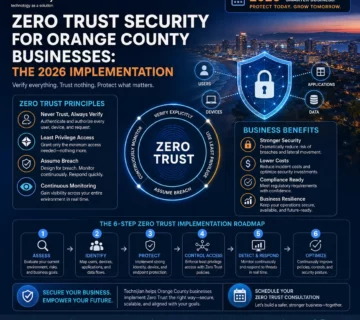
Zero Trust Security for Orange County Businesses: The 2026 Implementation

Zero Trust Security for Orange County Businesses: The 2026 Implementation Guide 

Zero Trust Security for Orange County Businesses is no longer optional in 2026. As traditional perimeter-based security fails in hybrid and cloud-driven environments, Zero Trust provides a modern approach based on “never trust, always verify.” This guide explains why legacy security models are ineffective, outlines the five pillars of Zero Trust architecture, and provides a practical implementation roadmap tailored for OC businesses. From identity verification and device compliance to microsegmentation and data protection, this blog helps organizations reduce breach risk, stop lateral movement, and secure critical systems in today’s evolving threat landscape. ... Read More

FBI Issues Major Cybersecurity Warnings:

FBI Issues Major Cybersecurity Warnings: What Orange County Businesses Must Do Now 

The latest FBI cybersecurity warning reveals a sharp rise in AI-powered scams, ransomware attacks, and router exploitation targeting businesses. With nearly $797 million lost to impersonation scams and increasing threats from nation-state actors, Orange County businesses must take immediate action. This blog outlines the key risks and provides practical steps to strengthen security, protect sensitive data, and stay ahead of evolving cyber threats. ... Read More
MongoBleed Security Crisis

MongoBleed Security Crisis: Protecting Your Database Infrastructure from CVE-2025-14847

MongoBleed (CVE-2025-14847), which affects numerous versions of the MongoDB database. This flaw originates in the zlib compression library, allowing unauthenticated attackers to trick servers into leaking sensitive memory data like credentials and private user information. With over 87,000 instances exposed globally, the report emphasizes that the exploit is actively being used in the wild and requires no login permissions to execute. To mitigate this threat, administrators are urged to patch their systems to safe versions or temporarily disable zlib compression in favor of more secure alternatives. The source also highlights the role of managed service providers like Technijian in helping organizations assess risks and implement comprehensive defense strategies. ... Read More
Cybersecurity 2025: 7 Attacks Targeting Small Businesses (and How to Stop Them)

Cybersecurity 2025: 7 Attacks Targeting Small Businesses (and How to Stop Them)

Small businesses face escalating cyber threats in 2025, with attackers specifically targeting companies with limited security infrastructure. From sophisticated phishing campaigns to ransomware attacks, cybercriminals exploit vulnerabilities in outdated systems and untrained staff. This comprehensive guide examines seven critical attack vectors threatening small businesses today and provides actionable strategies to defend against them. Implementing managed cybersecurity services has become essential for protecting sensitive data, maintaining customer trust, and ensuring business continuity in an increasingly dangerous digital landscape. ... Read More
ShadowV2 Botnet Exploits IoT Vulnerabilities

ShadowV2 Botnet Exploits IoT Vulnerabilities: AWS Outage Reveals New Cyber Threat

ShadowV2, a sophisticated, Mirai-based botnet targeting specific vulnerabilities within the global Internet of Things (IoT) ecosystem. This malware exploits both long-standing and newly discovered flaws in network-connected devices from manufacturers like D-Link and TP-Link, quickly recruiting routers and DVRs across six continents for large-scale attacks. Security experts believe the botnet’s activity, which was observed during a major service disruption, constitutes a carefully planned test run by experienced threat actors likely preparing to offer commercial distributed denial-of-service (DDoS) capabilities. The paper emphasizes that organizations must adopt critical defenses, including strict network segmentation, consistent firmware updates, and the retirement of end-of-life (EOL) equipment that no longer receives vendor security support. Additionally, the text concludes with information regarding Technijian, an IT services provider offering specialized security assessments and lifecycle management to help businesses mitigate risks associated with these pervasive IoT threats. ... Read More