AI-Native Software Development: The Complete Guide for Orange County Businesses in 2026
🎙️ Dive Deeper with Our Podcast!
Quick Summary: AI-native software development represents a fundamental shift in how applications are built, integrating artificial intelligence at the core rather than as an afterthought. For businesses in Irvine, Orange County, and throughout Southern California, adopting AI-native development approaches is reducing operational costs by 35-60%, accelerating time-to-market, and creating sustainable competitive advantages. This comprehensive guide explores how custom AI agents, large language models (LLMs), and generative engine optimization (GEO) are transforming software development for SaaS companies, healthcare organizations, and real estate firms across the region.
The technology landscape in Orange County is experiencing a seismic transformation. From the innovative startups clustering around the Irvine Spectrum to established enterprises at Newport Center, businesses are discovering that traditional software development approaches can no longer keep pace with market demands. The emergence of AI-native software development is not merely an incremental improvement but rather represents a complete paradigm shift in how we conceptualize, build, and deploy digital solutions.
Unlike conventional development methodologies that treat AI as a supplementary feature, AI-native development embeds intelligent capabilities into the very foundation of every application. This approach enables software to learn, adapt, and improve continuously, creating dynamic systems that evolve alongside your business requirements.
What is AI-Native Software Development and Why Does It Matter for Irvine Businesses?
AI-native software development is an architectural philosophy that positions artificial intelligence as the primary driver of application functionality rather than a bolted-on feature. This methodology fundamentally reimagines how software systems are designed, built, tested, and maintained. For companies operating in competitive markets like Irvine and greater Orange County, understanding this distinction is crucial for strategic technology investments.
Traditional software operates on rigid, predetermined logic where developers explicitly code every possible scenario and response. When requirements change or new edge cases emerge, significant development effort is required to update these systems. In contrast, AI-native applications leverage machine learning models, neural networks, and intelligent agents that can interpret context, recognize patterns, and make decisions dynamically.
Consider the difference between a conventional customer service chatbot that matches keywords to scripted responses versus an AI-native conversational agent that understands intent, maintains context across interactions, and genuinely resolves complex queries. The former frustrates customers with its limitations while the latter delivers experiences that rival human support representatives.
Key Differentiators of AI-Native Architecture
AI-native systems distinguish themselves through several fundamental characteristics. First, they employ continuous learning mechanisms that improve performance based on real-world usage data without requiring manual updates. Second, they utilize natural language interfaces that enable users to interact through conversation rather than navigating complex menus and forms. Third, they incorporate predictive capabilities that anticipate user needs and proactively surface relevant information or take helpful actions.
Perhaps most importantly, AI-native applications demonstrate contextual awareness, understanding not just what users explicitly request but also the circumstances, history, and goals underlying those requests. This contextual intelligence enables truly personalized experiences that feel intuitive and responsive.
How Custom AI Agents Are Reducing Operational Costs for Irvine SaaS Companies
The SaaS ecosystem thriving in Irvine represents one of Southern California’s most dynamic technology sectors. Companies operating in this space face intense pressure to deliver innovative features while controlling costs and maintaining exceptional user experiences. Custom AI agents have emerged as a transformative solution, automating complex workflows and delivering measurable return on investment.
Local SaaS providers implementing AI agents for customer onboarding report reducing manual support intervention by 47% while simultaneously improving customer satisfaction scores. The agents handle everything from initial setup assistance to feature discovery, proactively guiding users through optimal configurations based on their specific use cases and industry requirements.
Operational Cost Comparison: Traditional vs. AI-Driven Approaches
| Operational Area | Traditional Approach | AI-Native Approach | Typical Savings |
| Customer Support | 8-10 agents per shift | 2-3 agents + AI agents | 45-60% |
| Data Processing | Manual entry & validation | Automated extraction | 55-70% |
| Lead Qualification | Hours per prospect | Instant AI scoring | 40-55% |
| Content Creation | Days per asset | Hours with AI assist | 50-65% |
| Code Development | Full manual coding | AI-assisted generation | 30-45% |
| Quality Assurance | Manual testing cycles | AI-powered testing | 35-50% |
Beyond direct cost savings, AI agents deliver strategic value by freeing human team members to focus on high-value activities that require creativity, judgment, and relationship building. When routine queries and processes are handled automatically, your most talented employees can dedicate their expertise to innovation and growth initiatives.
Struggling to identify AI opportunities within your Irvine-based business? Claim your Free AI Readiness Audit from Technijian to discover how custom AI agents could reduce your operational costs while improving service quality. Our Orange County team brings deep local expertise to every engagement.
Beyond Traditional SEO: Why Orange County Businesses Need Generative Engine Optimization (GEO)
The search landscape has fundamentally transformed with the emergence of AI-powered search experiences. Google’s Search Generative Experience (SGE), ChatGPT search integration, and similar innovations are changing how consumers discover and evaluate businesses. For Orange County companies that have invested heavily in traditional SEO, adapting to Generative Engine Optimization (GEO) is essential for maintaining visibility.
Traditional SEO focused primarily on ranking in lists of blue links, optimizing for specific keywords, and earning backlinks. While these fundamentals remain relevant, GEO introduces additional considerations. AI search systems synthesize information from multiple sources, meaning your content must be structured to serve as authoritative source material that AI systems confidently reference and cite.
Businesses frustrated with declining organic traffic despite maintaining traditional SEO best practices are often experiencing the effects of this transition. When AI systems generate comprehensive answers directly in search results, users may never click through to individual websites. Success in this environment requires becoming the source that AI systems trust and quote.
Strategic Approaches to Generative Engine Optimization
Effective GEO strategies emphasize several key principles. First, content must be comprehensively authoritative, providing depth and expertise that AI systems recognize as trustworthy. Second, information must be structured with clear hierarchies, defined entities, and explicit relationships that machine learning models can easily parse and understand. Third, local relevance signals become increasingly important as AI systems personalize results based on geographic context.
For Orange County businesses, this means creating content that explicitly establishes local expertise and connections. References to regional landmarks, local business communities, and area-specific challenges help AI systems understand your geographic authority. When someone in Irvine asks an AI assistant for recommendations on IT services, your content’s local relevance directly influences whether you appear in the generated response.
A Step-by-Step Guide to Integrating Custom LLMs into Your Existing Enterprise Software
Enterprise organizations contemplating LLM integration face a critical decision: how to introduce these powerful capabilities while preserving investments in existing systems and maintaining operational stability. The following framework outlines a proven approach that minimizes risk while accelerating time-to-value.
Phase 1: Assessment and Architecture Planning
Successful LLM integration begins with comprehensive assessment of your current technology stack, data assets, and business processes. This phase identifies high-value integration opportunities where LLM capabilities would deliver measurable improvements. Key considerations include data quality and availability, security and compliance requirements, existing API infrastructure, and user workflow patterns.
Architecture planning determines whether to deploy cloud-based LLM services, fine-tune open-source models on proprietary data, or develop fully custom models. Each approach offers distinct tradeoffs in terms of cost, customization potential, data privacy, and operational complexity. The optimal choice depends heavily on your specific industry requirements and technical capabilities.
Phase 2: Pilot Implementation and Validation
Rather than attempting organization-wide deployment immediately, best practices recommend identifying a contained pilot project that can demonstrate value while limiting risk exposure. Ideal pilots address specific pain points with measurable improvement potential, involve enthusiastic stakeholders willing to provide feedback, and operate in environments where occasional errors can be tolerated during refinement.
Pilot implementation should include robust monitoring and evaluation mechanisms. Track not only technical performance metrics but also user adoption patterns, satisfaction levels, and business outcome impacts. This data informs subsequent scaling decisions and helps build organizational confidence in the technology.
Phase 3: Scaling and Optimization
With validated pilot success, organizations can confidently expand LLM integration across additional use cases and user populations. This phase requires attention to infrastructure scaling, governance frameworks, and change management. Training programs ensure employees understand how to effectively leverage new AI capabilities, while governance structures maintain appropriate oversight and compliance.
Continuous optimization refines model performance based on accumulated real-world data. Fine-tuning adjustments improve accuracy for your specific domain, prompt engineering enhancements yield better outputs, and integration refinements streamline user experiences. This iterative improvement cycle compounds value over time. 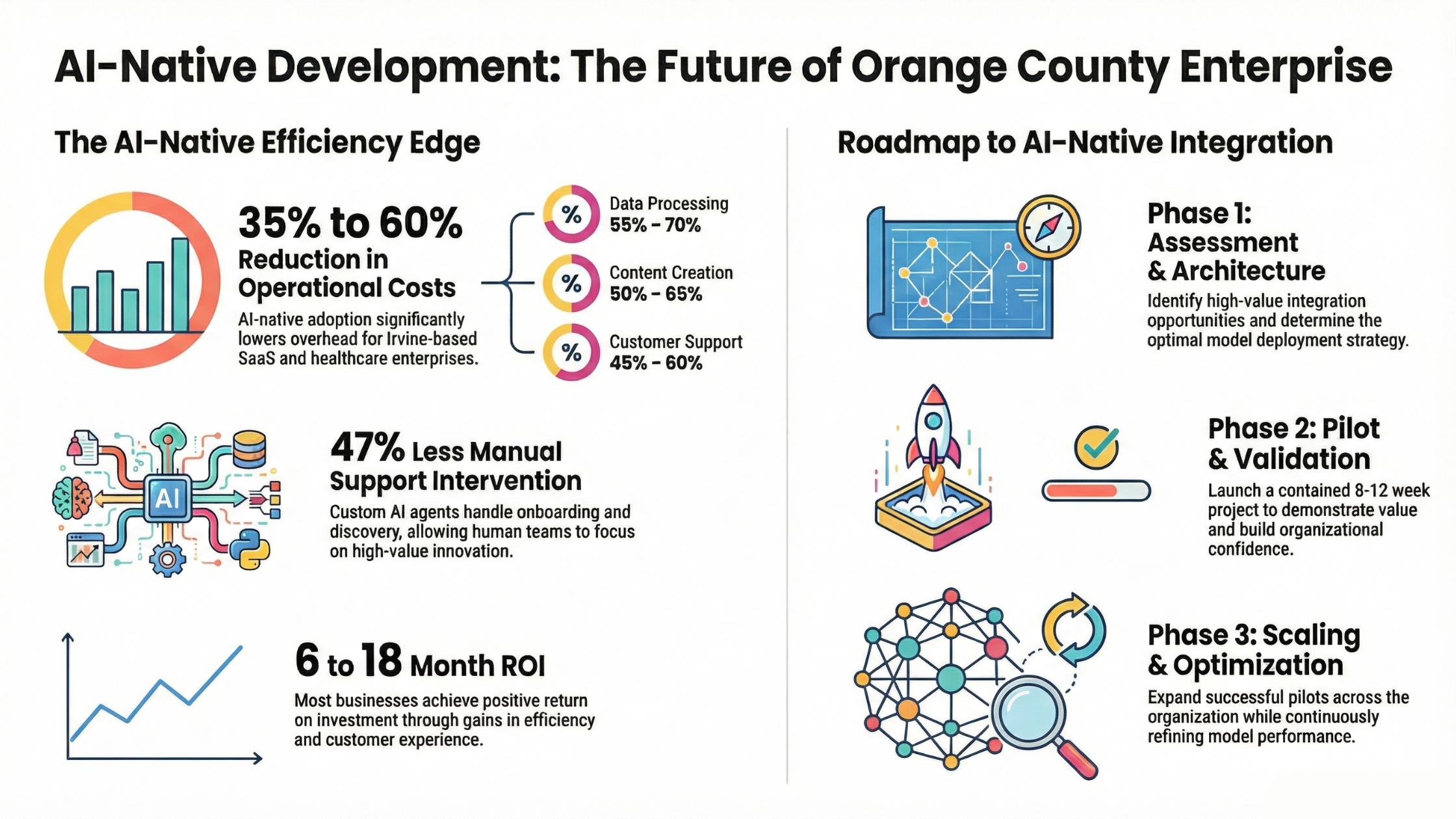
Why Hiring a Local AI Development Partner in Orange County Trumps Remote Outsourcing
While remote development teams and offshore outsourcing may appear cost-effective initially, organizations pursuing AI-native development increasingly recognize the strategic advantages of local partnership. These advantages become particularly pronounced when navigating the complexities of AI implementation in regulated industries or mission-critical applications.
Geographic proximity enables the collaborative, iterative development process that AI projects require. Unlike traditional software development where requirements can be fully specified upfront, AI initiatives involve continuous discovery, experimentation, and refinement. Face-to-face workshops, whiteboard sessions, and rapid prototyping cycles proceed more effectively when teams can meet in person.
Local partners understand the specific business environment, regulatory landscape, and competitive dynamics affecting Orange County organizations. This contextual knowledge proves invaluable when designing AI solutions that address real operational challenges. A development team familiar with California’s unique privacy requirements, for example, builds compliant systems from the foundation rather than retrofitting protections later.
The Value of Ongoing Partnership
AI-native applications require ongoing attention as models drift, requirements evolve, and new capabilities emerge. Local partners invested in your long-term success provide continuity that remote vendors cannot match. When urgent issues arise or strategic opportunities present themselves, responsive local expertise delivers decisive advantage.
The relationships formed through local partnership extend beyond technical delivery to genuine strategic collaboration. Partners who understand your business deeply can proactively identify AI opportunities, recommend emerging technologies, and help navigate the rapidly evolving landscape. This trusted advisor relationship creates compounding value over time.

AI-Native Development Applications Across Orange County Industries
Healthcare AI Solutions and Compliance Considerations
Orange County’s healthcare sector faces mounting pressure to improve patient outcomes while controlling costs and maintaining rigorous compliance. AI-native applications offer transformative potential in clinical decision support, administrative automation, and patient engagement while navigating complex regulatory requirements including HIPAA and California’s additional privacy protections.
Successful healthcare AI implementation requires careful attention to explainability, ensuring clinicians understand and can validate AI recommendations. Additionally, robust audit trails and governance frameworks demonstrate compliance to regulators while building trust with patients concerned about algorithmic decision-making in their care.
Real Estate AI for Lead Generation and Transaction Optimization
The competitive Orange County real estate market rewards agents and brokerages that leverage technology effectively. AI-native applications are revolutionizing lead generation through predictive analytics that identify likely sellers, intelligent nurturing sequences that maintain engagement over extended decision timelines, and automated transaction coordination that streamlines the closing process.
Property valuation models incorporating AI deliver more accurate estimates by processing complex combinations of comparable sales, market trends, property characteristics, and local factors. These insights help agents price listings competitively and provide clients with confidence-inspiring market analysis.
SaaS Product Enhancement Through AI Integration
Software-as-a-service companies headquartered around the Irvine Spectrum and throughout Orange County are discovering that AI capabilities have become table stakes for competitive products. Users increasingly expect intelligent features including natural language interfaces, predictive recommendations, and automated workflows that previously required premium add-ons.
AI-native development enables SaaS products to deliver personalized experiences at scale, with interfaces that adapt to individual user patterns and proactively surface relevant functionality. This intelligent personalization improves user adoption, increases engagement metrics, and reduces churn by continuously demonstrating value.
Strategic Keywords Driving AI Development Discovery in 2026
Understanding how potential clients search for AI development services helps inform content strategy and ensures visibility when decision-makers seek solutions. The following keyword categories represent commercial intent searches indicating readiness to engage with qualified providers.
| Category | High-Intent Keywords |
| Local AI Focus | AI development company Irvine, Custom AI solutions Orange County, Enterprise AI consulting CA, AI integration services Southern California |
| Problem-Solving | Automate business workflows with AI, How to build a custom LLM for business, AI agent development services, Workflow automation AI |
| Modern SEO/GEO | GEO services Irvine, AI Search Engine Optimization Orange County, Optimize content for ChatGPT search, Generative engine optimization California |
| Niche/Vertical | AI for real estate lead gen OC, SaaS AI integration Irvine, Healthcare AI compliance California, Custom AI for fintech Orange County |
Organizations searching these terms have typically moved beyond initial research and are actively evaluating potential implementation partners. Content addressing these queries should provide specific, substantive information demonstrating expertise and capability.
Emerging Trends Shaping AI-Native Development in 2026 and Beyond
The AI development landscape continues evolving rapidly, with several trends poised to reshape possibilities for Orange County businesses. Multimodal AI systems that seamlessly process text, images, audio, and video are enabling richer application experiences. Smaller, more efficient models are making sophisticated AI capabilities accessible to organizations with modest computational resources.
Agentic AI architectures that can autonomously plan and execute complex multi-step workflows are transitioning from research curiosities to production-ready tools. These systems dramatically expand automation possibilities, handling intricate processes that previously required human judgment and coordination across multiple systems.
Edge AI deployment is bringing intelligent capabilities directly to devices and local networks, reducing latency and addressing data sovereignty concerns. For industries with strict compliance requirements or real-time processing needs, edge deployment offers compelling advantages over cloud-dependent architectures.
Ready to explore how AI-native development can transform your business? Visit Technijian Ai-Driven Development to learn more about our comprehensive AI development services for Orange County businesses, or contact our Irvine team for a personalized consultation.
Frequently Asked Questions About AI-Native Software Development
What is the difference between AI-native and AI-enabled software development?
AI-enabled software incorporates AI features into applications designed around traditional architectures, essentially adding intelligence as an enhancement to existing functionality. AI-native software, in contrast, is architected from the ground up with AI as the core operational principle. This fundamental difference affects everything from data architecture to user interface design. AI-native applications leverage intelligent capabilities throughout the entire system rather than in isolated features, enabling more sophisticated, adaptive, and contextually aware experiences.
How much does custom AI agent development cost for Irvine businesses?
Investment requirements vary significantly based on project scope, complexity, and specific requirements. Initial pilot projects integrating AI agents into existing workflows typically range from $25,000 to $75,000, enabling organizations to validate value before committing to larger initiatives. Comprehensive AI-native application development for enterprise requirements generally ranges from $150,000 to $500,000 or more, depending on integration complexity, compliance requirements, and customization depth. Most Orange County businesses realize positive ROI within 6-18 months through operational efficiency gains and improved customer experiences.
Can existing enterprise software be retrofitted with AI-native capabilities?
While true AI-native architecture requires purpose-built systems, existing enterprise applications can be substantially enhanced through strategic AI integration. This hybrid approach preserves investments in current platforms while introducing intelligent capabilities through API integrations, microservices architectures, and AI-powered middleware layers. The optimal strategy depends on your current technology stack, business objectives, and timeline requirements. Many organizations pursue phased approaches that incrementally introduce AI capabilities while planning eventual migration to fully AI-native architectures.
What security and compliance considerations apply to AI development in California?
California businesses must navigate both federal regulations and state-specific requirements including the California Consumer Privacy Act (CCPA) and California Privacy Rights Act (CPRA). AI systems processing personal information must implement appropriate data protection measures, honor consumer rights requests, and maintain transparency about automated decision-making. Industry-specific regulations add additional layers; healthcare organizations must ensure HIPAA compliance while financial services firms must address relevant SEC and FINRA guidance. Working with development partners familiar with California’s regulatory environment helps ensure compliant implementations.
How does Generative Engine Optimization (GEO) differ from traditional SEO?
Traditional SEO optimizes content to rank highly in search engine results pages, focusing on keywords, backlinks, and technical factors that influence ranking algorithms. GEO addresses the emerging challenge of visibility in AI-generated search responses, where systems like Google SGE and ChatGPT synthesize information from multiple sources to answer queries directly. GEO strategies emphasize becoming a trusted authoritative source that AI systems reference and cite, requiring structured content formats, comprehensive topical coverage, and strong E-E-A-T signals. Both disciplines remain important as search experiences continue evolving.
How long does it typically take to implement custom AI solutions for enterprise applications?
Implementation timelines depend heavily on project scope and organizational readiness. Focused pilot projects can launch within 8-12 weeks, providing initial value while informing subsequent phases. Comprehensive AI-native application development typically requires 4-9 months from initial discovery through production deployment. Enterprise-wide digital transformation initiatives incorporating AI across multiple systems and processes may span 12-24 months. Phased approaches that deliver incremental value throughout the development process help maintain momentum and stakeholder support during longer engagements.
How Technijian Can Help Your Orange County Business Embrace AI-Native Development
Since 2000, Technijian has served as Orange County’s trusted technology partner, helping businesses across Irvine, Newport Beach, Costa Mesa, and throughout Southern California navigate evolving technology landscapes. Our AI-driven development services combine deep local expertise with cutting-edge technical capabilities to deliver transformative results.
Our comprehensive approach to AI-native development encompasses strategy consulting, custom development, integration services, and ongoing optimization. Whether you’re exploring initial AI opportunities or ready to undertake ambitious digital transformation, our experienced team provides the guidance and execution capability to achieve your objectives.
Custom AI Agent Development: We design and build intelligent agents tailored to your specific business processes, automating workflows, enhancing customer experiences, and driving operational efficiency. Our agents integrate seamlessly with existing systems while delivering measurable ROI.
LLM Integration Services: From strategy through deployment, we help organizations leverage large language models effectively. Our services include API integration, custom fine-tuning, prompt engineering, and responsible AI governance framework development.
Generative Engine Optimization: Our GEO services ensure your business maintains visibility as AI-powered search transforms how customers discover solutions. We optimize content structure, authority signals, and machine-readable formatting for the AI-first search landscape.
AI Readiness Assessments: Not sure where to begin? Our complimentary AI readiness audit evaluates your current technology environment, identifies high-value opportunities, and provides a prioritized roadmap for AI adoption aligned with your business objectives.
As your local partner, we understand the unique challenges and opportunities facing Orange County businesses. Our team combines technical excellence with genuine commitment to client success, delivering solutions that create lasting competitive advantage.
Ready to Transform Your Business with AI-Native Development?
Contact Technijian today to schedule your complimentary AI Readiness Assessment.
Visit: technijian.com/ai-driven-development
Call: (949) 379-8499 | Email: sales@technijian.com
Serving Irvine, Orange County, and all of Southern California since 2000
Related Resources
Explore our comprehensive AI-Driven Development Services to learn how we help Orange County businesses leverage cutting-edge AI technologies.
Discover our full range of Managed IT Support Services for comprehensive technology management that keeps your business running smoothly.
Learn about our Cybersecurity Solutions to ensure your AI implementations maintain robust security postures.