Enterprise AI Guide

Enterprise AI Guide 2026: How Smart Businesses Are Scaling with Artificial Intelligence

Enterprise AI is no longer just for Fortune 500 companies—by 2026 it’s a competitive advantage for mid-size and large organizations across every industry. This guide explains what enterprise AI really is (and how it differs from consumer AI), why the Enterprise AI Guide 2026 framework helps businesses adopt AI with structure and confidence, and the five pillars required for success: data readiness, use case prioritization, integration, governance/security, and change management. It also highlights high-impact 2026 use cases—customer support automation, predictive analytics, document processing, AI-driven cybersecurity, and productivity tools—plus what Orange County companies must consider around compliance and talent. Finally, it outlines a practical roadmap to get started and how Technijian helps businesses deploy secure, scalable, ROI-focused AI solutions. ... Read More
AI Policy Templates: Keep Your Teams Secure While Using ChatGPT

AI Policy Templates: Keep Your Teams Secure While Using ChatGPT

The crucial need for organizations to establish comprehensive AI governance frameworks and AI usage policies immediately, driven by the finding that most employees use AI tools without company guidelines. The sources emphasize that unmanaged AI adoption exposes businesses to serious threats, including the potential for data leakage of confidential information, intellectual property disputes, and costly compliance violations of regulations such as GDPR and HIPAA. To address these vulnerabilities, effective policies must define data classification guidelines, mandate the use of approved AI tools, and establish verification requirements to prevent flawed decision-making based on AI outputs. Furthermore, the imperative for secure AI requires continuous oversight from a governance committee, regular risk assessment of new tools, and mandatory training programs to ensure that employees understand responsible usage protocols. The overall goal is to strike a practical balance between leveraging AI's innovative capabilities and maintaining strict security controls, often achieved through external expertise in compliance management. ... Read More
HIPAA + AI

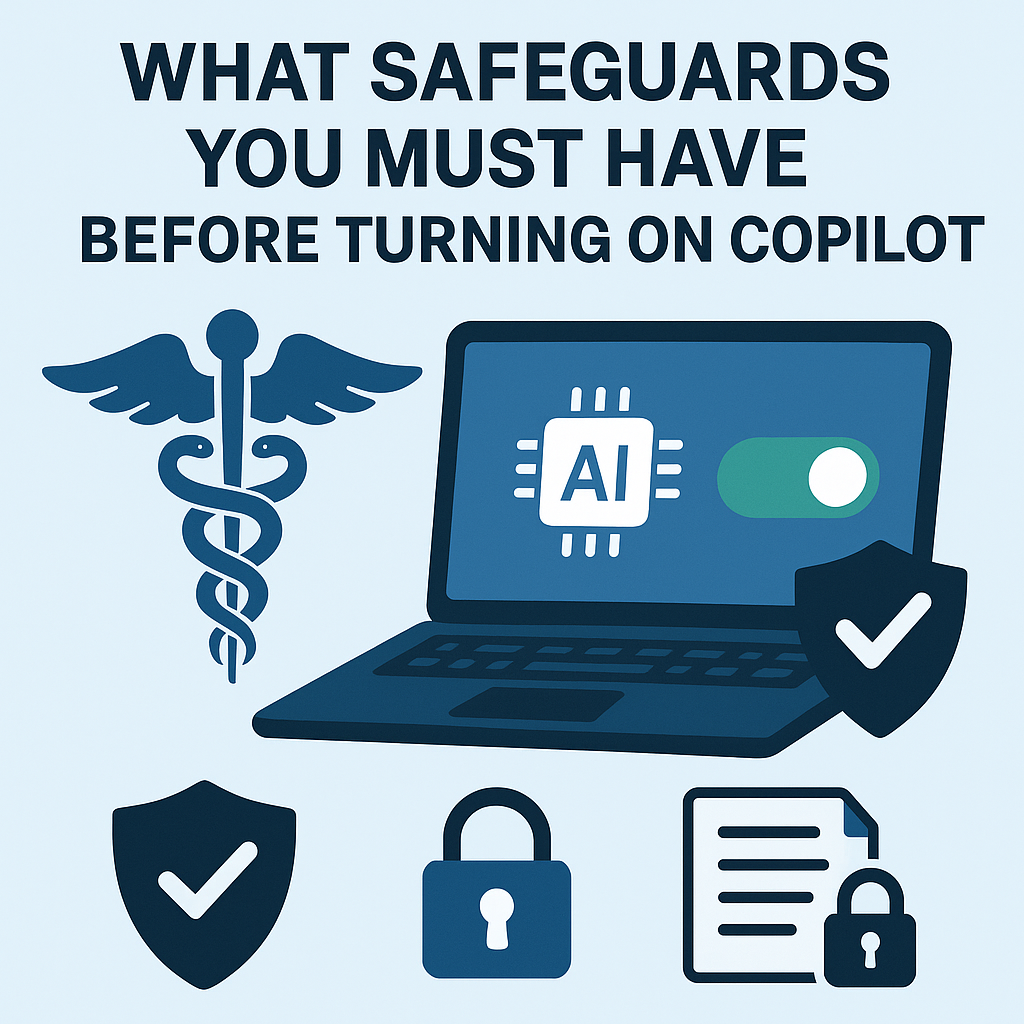
HIPAA + AI: What Safeguards You Must Have Before Turning On Copilot

HIPAA compliance when deploying Microsoft 365 Copilot within healthcare organizations. It warns that utilizing Copilot without specific safeguards can lead to catastrophic regulatory fines, mandatory breach notifications, and potential criminal charges due to the exposure of Protected Health Information (PHI). The text details twelve critical steps required for a compliant implementation, including conducting a pre-deployment risk assessment, obtaining the correct Business Associate Agreement (BAA), implementing strict permission controls using the principle of least privilege, and configuring Data Loss Prevention (DLP) policies specifically for Copilot interactions. Furthermore, the source emphasizes the importance of addressing challenges unique to AI, such as shadow AI use, oversharing through misconfigured permissions, and inadequate audit controls. Finally, it positions professional IT services as necessary for small and mid-sized healthcare practices to navigate these complex technical and administrative requirements successfully. ... Read More