
Compliance

Microsoft 365 Retention Planning Checklist planning for an Orange County business

My Office — Microsoft 365 Retention Planning for Law Firms

My Office — Microsoft 365 Retention Planning for Law Firms gives legal leaders and IT owners a practical framework for retaining matter information correctly without keeping everything forever. This guide covers identifying information owners, inventorying Microsoft 365 locations, classifying business information, distinguishing retention from backup, designing policy and exceptions, piloting and validating behavior, documenting operations and evidence, and reviewing after material changes. Orange County law firms can use it to document current retention practice, assign accountable owners, prioritize gaps, coordinate records, compliance and technology teams, and connect findings to a realistic retention policy. It also explains the failure patterns to avoid and how to repeat the review after changes to systems, vendors, personnel, policies, risks, or client obligations. Use the policy as an operating process rather than a one-time exercise. ... Read More

Cmmc compliance it support planning covering CMMC managed services, defense contractor IT compliance, and CMMC readiness support

CMMC Compliance IT Support for Defense Suppliers

Plan CMMC compliance IT support with a clear view of the business decisions, technical dependencies, and ownership questions involved. This practical guide explains how Orange County leaders can define outcomes, document the current environment, compare options, coordinate compliance responsibilities, protect continuity, and set realistic implementation expectations. It also covers security, employee workflows, vendor accountability, testing, escalation, reporting, and the questions to ask before approving a change. Use the decision framework to align technical and business stakeholders, reduce avoidable disruption, clarify who owns each next step, and choose a path that fits the organization's users, risks, growth plans, operating priorities, and long-term technology strategy. It supports a practical accountable decision based on documented business priorities. ... Read More
Software Bill of Materials for Business Leaders: Why SBOMs Matter in 2026 featured image

Software Bill of Materials for Business Leaders: Why SBOMs Matter in 2026

Software Bill of Materials for Business Leaders: Why SBOMs Matter in 2026 gives business and technology leaders a practical framework for making better software decisions in 2026. The article explains what to evaluate before, during, and after development work so projects are easier to manage and less likely to create avoidable risk. Readers will learn how to think about requirements, budgets, vendors, security, technical debt, testing, documentation, release planning, and long-term ownership. It is written for executives, product owners, and operations teams that need clear guidance without getting buried in engineering jargon. Technijian can help assess software needs, improve project planning, review technical risks, and support custom development initiatives with stronger governance. ... Read More
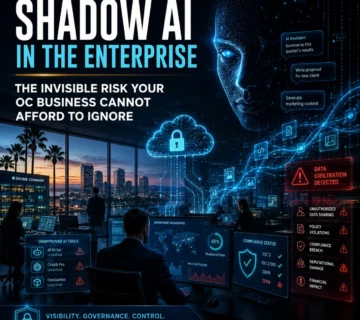
Shadow AI in the Enterprise: The Invisible Risk Your OC Business Cannot Afford to Ignore

Shadow AI in the Enterprise: The Invisible Risk Your OC Business Cannot Afford to Ignore 

Shadow AI Risks Enterprise Management 2026 explains how employees using unauthorized AI tools can expose sensitive business data, client information, intellectual property, and regulated records. This blog covers why shadow AI is spreading quickly across enterprises, the risks it creates for OC businesses, and how a practical AI governance framework can help organizations discover, classify, monitor, and safely manage AI usage without slowing productivity. ... Read More
Cloud Backup for HIPAA Practices

Cloud Backup for HIPAA Practices: The 2026 Guide for Medical Offices in Orange County

A HIPAA-compliant cloud backup must include a signed Business Associate Agreement (BAA), AES-256 encryption at rest, TLS 1.3 in transit, immutable storage (object lock or WORM), customer-managed encryption keys, off-site geographic redundancy, role-based access with MFA, audit logging retained for 6 years, and quarterly tested recovery procedures. Consumer cloud services like Dropbox Personal, Google Drive Personal, and OneDrive Personal are not HIPAA-compliant. ... Read More