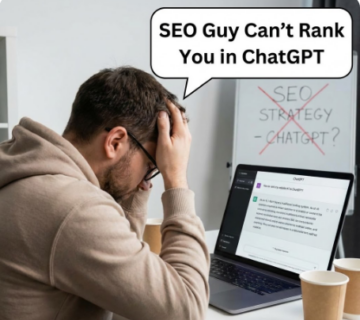
Why Your ‘SEO Guy’ Can’t Rank You in ChatGPT
🎙️ Dive Deeper with Our Podcast!
Summary: In 2026, the landscape of SEO is rapidly evolving with the rise of AI-powered search engines like ChatGPT. Traditional SEO methods focused on Google rankings are no longer sufficient to secure visibility. This blog explores the shift to Answer Engine Optimization (AEO), explaining why businesses in Orange County need to optimize for AI platforms to stay competitive. Learn about the importance of schema markup, direct-answer content, and AI citation monitoring to enhance your business’s presence in AI search results and drive more relevant traffic.
You’re paying an SEO agency $3,000 a month. They send you a report every thirty days showing keyword rankings, backlink counts, and organic traffic charts. Everything looks respectable on paper. But then a potential customer asks ChatGPT to recommend the best HVAC company in Costa Mesa—or the top-rated dental practice near Irvine Spectrum—and your business is nowhere in the response. Not first. Not fifth. Not mentioned at all.
Meanwhile, a competitor with a fraction of your marketing budget is consistently cited by ChatGPT, Perplexity, and Google’s AI Overviews as the go-to answer in your category. What happened?
The answer is straightforward: your SEO provider is optimizing for a search ecosystem that is fundamentally changing. Traditional SEO—the kind focused exclusively on Google’s blue-link rankings—is no longer sufficient. In 2026, a growing percentage of your potential customers are finding businesses through AI-powered answer engines that operate on entirely different principles than the Google algorithm your SEO team was trained on.
This article explains why the traditional SEO playbook falls short in the age of AI search, what Answer Engine Optimization (AEO) actually requires, and how Orange County businesses can adapt before their competitors claim the AI visibility advantage permanently.
The AI Search Revolution: Numbers Your SEO Agency Isn’t Showing You
The shift from traditional search to AI-powered discovery is not a future prediction—it is happening right now, at a pace that has caught most marketing agencies off guard. Consider these figures:
| 800 Million+ | Weekly active ChatGPT users as of early 2026, processing over 2.5 billion prompts daily |
| 12% | ChatGPT’s estimated share of Google’s total search volume—now exceeding Bing’s market share |
| 64% | Of all Google searches in 2025 ended without a single click to any external website |
| 81% | ChatGPT’s market share among AI chatbot and search platforms globally |
| 90% | Of ChatGPT citations come from pages ranking outside Google’s top 20 results |
That last statistic deserves special attention. It means the pages ChatGPT chooses to cite and recommend are frequently not the same pages that rank well on Google. The authority signals, content formats, and structural patterns that AI engines prioritize are fundamentally different from the factors that determine traditional search rankings.
For Orange County business owners and CMOs, this creates an uncomfortable reality: the SEO strategy you’re paying for may be optimizing for a shrinking portion of how customers actually discover businesses in 2026.
Five Reasons Traditional SEO Cannot Rank You in AI Search
1. AI Engines Don’t Read Rankings—They Read Authority Signals
Google’s algorithm ranks pages based on a complex formula of backlinks, domain authority, page speed, and keyword optimization. AI search engines like ChatGPT and Perplexity work differently. They analyze semantic consistency—whether your content is recognized across the web as the authoritative answer on a specific topic. They evaluate structured data, citation patterns, and topical depth rather than link counts and keyword density.
Your traditional SEO agency is building backlinks and optimizing meta titles. Meanwhile, AI engines are looking for businesses that provide clear, comprehensive, well-structured answers to the exact questions people ask—and that are referenced by other credible sources as the definitive authority on that subject.
2. Keyword Stuffing Is Invisible to AI Answer Engines
Traditional SEO often relies on inserting target keywords into headings, body text, and meta descriptions at strategic densities. AI engines do not scan for keyword frequency. They evaluate whether your content genuinely and thoroughly answers a user’s question. A page optimized with the phrase “best dental practice Irvine Orange County” repeated seventeen times will not outperform a comprehensive guide that naturally addresses what patients actually want to know: qualifications, specializations, patient reviews, insurance acceptance, and appointment availability.
3. AI Search Favors Direct Answers Over Long-Form Filler
Many SEO agencies inflate blog posts with padding—lengthy introductions, tangential anecdotes, and repetitive restating of obvious points—because longer content historically correlated with higher Google rankings. AI engines strip away the filler. They extract the clearest, most direct answer to a user’s question. Content that buries the answer beneath 800 words of preamble gets passed over in favor of content that leads with the answer and supports it with evidence.
4. Schema Markup and Structured Data Are Non-Negotiable for AI Visibility
Schema markup—the machine-readable code that tells search engines what your content means, not just what it says—is one of the strongest signals AI engines use to identify and cite businesses. Local business schema, FAQ schema, review schema, service schema, and organization schema all help AI platforms understand that your business provides specific services in specific locations.
Most traditional SEO agencies handle schema as an afterthought, if they handle it at all. For AI search optimization, it is foundational infrastructure. Without robust structured data, your business is essentially invisible to the machines that are increasingly deciding which companies get recommended.
5. Technical Performance Is Table Stakes, Not a Bonus
Core Web Vitals—page load speed, visual stability, and interactivity metrics—have always mattered for Google rankings. For AI search, technical performance is even more critical because AI engines tend to favor sources they can crawl efficiently and that provide clean, well-organized content. A site with a three-second Largest Contentful Paint, broken internal links, and missing HTTPS is not just ranking poorly on Google; it is being excluded from AI training data and citation pools altogether.
Your SEO provider may be writing blog posts and building links while your website’s technical foundation is quietly disqualifying you from an entirely new discovery channel.
Traditional SEO vs Answer Engine Optimization: A Side-by-Side Comparison
| Dimension | Traditional SEO | Answer Engine Optimization |
| Primary Goal | Rank on Google’s Page 1 for target keywords | Get cited and recommended by ChatGPT, Perplexity, Gemini, and AI Overviews |
| Success Metric | Organic rankings, clicks, impressions | AI citations, brand mentions, answer visibility across AI platforms |
| Content Strategy | Long-form blog posts targeting keyword volume | Direct-answer content structured as Problem → Solution with evidence |
| Authority Signal | Backlink quantity and domain authority score | Semantic consistency, topical depth, cross-platform citation patterns |
| Technical Focus | Page speed and mobile-friendliness | Schema markup, structured data, clean crawlable architecture, FAQ formatting |
| Local Optimization | Google Business Profile, NAP consistency, map pack | Structured local schema, review aggregation, AI-parseable business information |
| Content Format | 800–2,000 word articles with keyword density targets | FAQ blocks, comparison tables, code snippets, and concise expert-level answers |
| Measurement | Google Search Console and Analytics dashboards | AI platform monitoring, citation tracking, answer engine brand visibility audits |
| The critical insight: traditional SEO and AEO are not mutually exclusive. A properly executed strategy addresses both channels simultaneously. The problem is that most SEO agencies only know how to execute the left column. |
What Answer Engine Optimization Actually Requires
If traditional SEO is about convincing Google’s algorithm that your page deserves a ranking, Answer Engine Optimization is about convincing AI systems that your business deserves a recommendation. That distinction matters because the skill sets are different:
- Comprehensive Schema Markup Implementation: Your website needs LocalBusiness, FAQPage, Service, Review, Organization, and Product schema deployed correctly across every relevant page. This is not a one-time task—it requires ongoing maintenance as your services, locations, and content evolve.
- Direct-Answer Content Architecture: Every piece of content must be structured to deliver clear, authoritative answers in formats AI engines prefer: FAQ blocks with question-and-answer pairs, comparison tables, step-by-step guides, and concise expert summaries.
- Topical Authority Building: Instead of chasing hundreds of disconnected keywords, AEO demands deep coverage of core topics. If your business is a dental practice in Irvine, your website should be the single most comprehensive resource on dental care in the Irvine market—covering procedures, insurance, patient education, and local-specific information.
- Technical SEO Infrastructure: Core Web Vitals scores in the green zone, clean URL architecture, proper internal linking, working HTTPS, XML sitemaps, and crawl-efficient page structure. These are not ranking factors alone—they determine whether AI engines can access and trust your content at all.
- Cross-Platform Brand Consistency: AI engines evaluate how consistently your business is described across the web. Your Google Business Profile, Yelp listing, industry directories, social media profiles, and website must present the same name, address, phone number, services, and positioning. Inconsistencies confuse AI systems and reduce your citation likelihood.
- AI-Specific Content Formats: Include elements AI engines specifically favor: code blocks for technical topics, structured comparison tables, definitions at the top of articles, and properly formatted FAQ sections that map directly to how users phrase questions to AI assistants.
How Technijian Gets Your Business Ranked in ChatGPT, Google, and Every Platform Between
Technijian is not a traditional SEO agency. We are a technical SEO and Answer Engine Optimization firm built from the ground up for the 2026 search landscape—where AI citations matter as much as Google rankings, and where the technical infrastructure behind your website determines whether AI platforms ever discover your business at all.
We call our approach “Infrastructure for Growth”: we build the technical engine room that makes your marketing campaigns actually work.
| Technijian AEO Capability | What This Means for Your Visibility |
| Full Schema Markup Engineering | We deploy comprehensive structured data across your entire website—LocalBusiness, FAQ, Service, Review, and Organization schema—so AI engines understand exactly what your business offers, where you operate, and why you are the authority in your market. |
| Answer Engine Content Strategy | We create direct-answer content architectures built for AI citation: FAQ blocks, comparison tables, expert summaries, and problem-solution structures that AI engines prefer to reference and recommend. |
| Technical SEO Infrastructure | Core Web Vitals optimization, server-side rendering, clean URL architecture, internal linking, HTTPS enforcement, crawl budget management, and XML sitemap optimization. We fix the code-level issues that most marketing agencies cannot even diagnose. |
| AI Citation Monitoring | We track your brand’s visibility across ChatGPT, Perplexity, Google AI Overviews, and Gemini—providing actionable reporting on where you are being cited, where competitors are outperforming you, and what content changes will close the gap. |
| Local SEO + AI Local Optimization | Google Business Profile optimization plus structured local schema that helps AI engines connect your business to specific cities, zip codes, and neighborhoods across Orange County—including Costa Mesa, Anaheim, Irvine, Long Beach, and Newport Beach. |
| Transparent Pricing, Measurable Results | No jargon-filled reports designed to confuse you. We provide clear ROI tracking across both traditional Google rankings and AI platform citations, with monthly strategy reviews in plain language. |
| “Most SEO agencies sell you rankings. We sell you visibility—on Google, in ChatGPT, on Perplexity, and everywhere your customers are actually searching. If your SEO provider can’t explain their AEO strategy, they’re optimizing for yesterday’s search engine.” — Technijian Digital Marketing |
Frequently Asked Questions
Q: What is Answer Engine Optimization (AEO)?
A: Answer Engine Optimization is the practice of structuring your website content, technical infrastructure, and online presence so that AI-powered platforms—ChatGPT, Perplexity, Google AI Overviews, Gemini—recognize your business as an authoritative source and cite or recommend you in their responses. AEO encompasses schema markup, direct-answer content formatting, topical authority building, and cross-platform brand consistency.
Q: Is traditional SEO dead?
A: No. Traditional SEO remains important because Google still processes trillions of searches annually. However, relying exclusively on Google-focused SEO means ignoring a rapidly growing channel where hundreds of millions of people now discover businesses. The most effective strategy combines traditional SEO with Answer Engine Optimization to capture visibility across both ecosystems.
Q: How do I check if my business appears in ChatGPT search results?
A: You can test manually by asking ChatGPT questions your customers would ask, such as ‘best [your service] in [your city]’ or ‘who provides [specific service] near [location].’ For systematic monitoring, Technijian provides AI citation tracking that continuously monitors your brand’s visibility across multiple AI platforms and delivers actionable reports.
Q: Why does ChatGPT recommend my competitor but not my business?
A: AI engines recommend businesses based on topical authority, structured data, content quality, and cross-platform consistency—not just Google rankings. Your competitor may have better schema markup, more comprehensive FAQ content, stronger review profiles, or more consistent business information across the web. A technical AEO audit from Technijian can identify exactly where the gaps exist.
Q: What is schema markup and why does it matter for AI search?
A: Schema markup is machine-readable code added to your website that tells AI engines and search engines what your content means. For a local business, schema communicates your services, location, hours, reviews, and pricing in a format AI can directly parse and cite. Without schema, AI platforms must guess what your website offers—and they frequently guess wrong or skip your site entirely.
Q: Can Technijian help my business rank on both Google and ChatGPT simultaneously?
A: Yes, and that is precisely our approach. We build technical SEO infrastructure that serves both Google’s algorithm and AI answer engines. Schema markup helps Google and AI platforms. Direct-answer content improves featured snippet capture on Google and AI citations simultaneously. Technical performance optimization benefits all discovery channels.
Q: How much does Answer Engine Optimization cost for a small business in Orange County?
A: AEO investment varies based on your industry, competitive landscape, and current website infrastructure. Technijian offers transparent, tiered pricing specifically designed for OC small businesses—from local service providers in Costa Mesa and Anaheim to growing companies in Irvine and Long Beach. Contact us for a complimentary AEO audit and customized proposal.
Q: How long before I see results from AEO?
A: Technical improvements like schema markup and site speed optimization can produce measurable changes in AI citation visibility within four to eight weeks. Topical authority building and content strategy produce compounding results over three to six months. Unlike traditional SEO, which can take six to twelve months for ranking improvements, AEO often delivers faster initial visibility because AI platforms evaluate authority signals differently than Google.
Q: Does Technijian serve businesses outside of Irvine?
A: Absolutely. We are headquartered in Irvine and serve businesses across all of Orange County—including Costa Mesa, Anaheim, Newport Beach, Long Beach, Santa Ana, Tustin, and the broader Southern California region. Our digital marketing clients span local service businesses, healthcare practices, retail operations, manufacturers, hospitality companies, and professional services firms.
Q: How do I get started with Technijian’s AEO and SEO services?
A: Call us at (949)-379-8500 or visit technijian.com to request a compl imentary AI visibility audit. We will assess how your business currently appears across Google, ChatGPT, Perplexity, and AI Overviews, identify the technical and content gaps limiting your visibility, and deliver a clear, prioritized action plan with transparent pricing.
Is Your Business Invisible to AI Search?
Get a complimentary AI Visibility Audit from Technijian and discover how your business appears in ChatGPT, Perplexity, and Google AI Overviews.
☎ (949)-379-8500
🌐 technijian.com
Related Topics:
AI SEO services Orange County Irvine • answer engine optimization for local businesses Irvine • ChatGPT search ranking specialist Orange County • technical SEO agency Irvine California • SEO for medical practices Orange County 2026 • local SEO pricing Orange County transparent rates • LLM optimization services Irvine tech companies • affordable SEO for small business Costa Mesa • local search optimization Costa Mesa retail • automotive dealer SEO Costa Mesa 92626 • SEO for Anaheim manufacturers • hospitality SEO near Disneyland Resort • healthcare SEO Long Beach medical practices • logistics company SEO near Port of Long Beach • SEO for Long Beach small businesses 90802