Cybersecurity Awareness: Best Practices & Risk Prevention

Cybersecurity awareness is crucial for individuals and businesses to safeguard sensitive data from cyber threats. Phishing scams, ransomware attacks, and data breaches are on the rise, making it essential to educate employees and implement strong security measures. By staying informed about the latest threats and adopting proactive cybersecurity practices, organizations can reduce risks and protect their digital assets. Prioritizing cybersecurity awareness fosters a security-conscious culture, ensuring long-term protection against evolving cyber dangers.

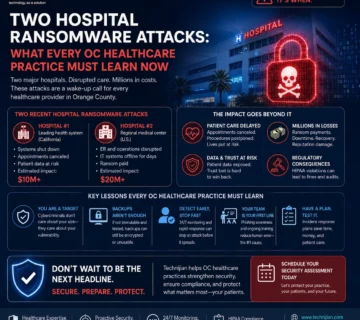
Two Hospital Ransomware Attacks: What Every OC Healthcare Practice Must Learn Now

Two Hospital Ransomware Attacks in 60 Days: What Every OC Healthcare Practice Must Learn Now 

In 2026, healthcare organizations across the U.S. faced severe ransomware attacks that disrupted patient care and exposed critical data. Practices in Orange County must understand the growing threat, which targets not only large hospitals but also small clinics and medical offices. This blog explores the latest ransomware trends, their impact on patient safety, and essential lessons for securing healthcare IT systems, including backup strategies, third-party vendor risks, and the importance of multi-factor authentication (MFA). With rising ransomware threats, every healthcare practice must act proactively to protect their operations and patient data. ... Read More

ClickFix Attack Fake BSOD Malware

ClickFix Attack Uses Fake BSOD Screens to Deploy Malware

A sophisticated social engineering campaign known as ClickFix, which targets employees in the hospitality industry by mimicking legitimate Booking.com communications. The attack leverages fake Blue Screen of Death (BSOD) errors to manipulate panicked users into executing malicious PowerShell scripts. Once the victim follows the deceptive instructions, a remote access trojan called DCRAT is installed, granting hackers total control over the infected system and its sensitive data. Because these threats utilize legitimate system tools to evade detection, the source emphasizes the necessity of specialized cybersecurity training and advanced monitoring. Ultimately, the report highlights how modern cybercriminals exploit psychological pressure and industry-specific workflows to bypass traditional security measures. ... Read More
ErrTraffic: Automating ClickFix Social Engineering Attacks

New ErrTraffic Service Enables ClickFix Attacks Through Fabricated Browser Errors

ErrTraffic is a sophisticated cybercrime platform that automates social engineering attacks by generating fake technical errors on compromised websites. This service facilitates ClickFix attacks, which deceive users into believing their browser or system is malfunctioning and requires a manual repair. When victims follow the provided instructions to “fix” these artificial glitches, they inadvertently execute PowerShell commands that install information-stealing malware tailored to their specific operating system. The platform is highly effective due to its automated filtering, which targets specific geographic regions while maintaining a high conversion rate through psychological manipulation. To defend against these threats, organizations must prioritize user awareness training and implement robust website security monitoring to detect unauthorized code injections. Protecting systems requires a healthy skepticism of unexpected technical prompts, as legitimate software updates are never delivered through suspicious website commands. ... Read More
Cybercriminals Exploit Google Ads to Spread macOS Malware

Cybercriminals Exploit Google Ads to Spread macOS Malware Through Fake AI Conversations

A sophisticated new malware campaign targeting macOS users that exploits public trust in artificial intelligence platforms. This attack, which utilizes the AMOS infostealer, begins when cybercriminals purchase Google search advertisements that direct victims to seemingly helpful conversations on AI platforms like ChatGPT or Grok, which contain malicious terminal commands. When executed, these commands install the AMOS malware to systematically steal sensitive information, including cryptocurrency wallet data, browser credentials, and macOS Keychain contents. The text emphasizes that this is a dangerous evolution in social engineering, relying on victims to unknowingly grant administrative privileges. Finally, the sources shift to a promotional focus, with Technijian presenting itself as a managed IT services provider that offers advanced security solutions, incident response, and user awareness training to protect organizations from such sophisticated threats. ... Read More