Two Hospital Ransomware Attacks: What Every OC Healthcare Practice Must Learn Now
🎙️ Dive Deeper with Our Podcast!
The News: A Healthcare Sector Under Siege
Two significant ransomware attacks on healthcare organizations in the first quarter of 2026 have sent a clear signal to every medical practice, clinic, and healthcare IT team in Orange County: the threat is escalating, and it is not limited to large hospital systems.
On February 19, 2026, the University of Mississippi Medical Center, one of Mississippi’s largest health systems, suffered a devastating ransomware attack that forced all 35 of its statewide clinics to close and cancel appointments and surgeries. Clinical staff reverted to pen and paper. The FBI surged resources nationally in response. Patients faced delays in cancer treatment, chronic disease management, and surgical procedures.
Then on April 6, 2026, Signature Healthcare’s Brockton Hospital in Massachusetts was hit. Ambulances were diverted. Chemotherapy infusions at the Greene Cancer Center were cancelled. Pharmacies were closed and unable to fill prescriptions. The Anubis ransomware-as-a-service group later claimed responsibility, stating they had stolen 2 terabytes of data including a large volume of patient information, and had encrypted systems. As of mid-April, the hospital confirmed it would remain under downtime procedures for at least two weeks, with staff operating entirely on paper.
Two attacks. Sixty days apart. Different states, different health systems, same playbook, and the same devastating operational impact on patient care.
Why These Attacks Matter to OC Healthcare Practices
Orange County healthcare professionals might conclude that hospital ransomware attacks in Mississippi and Massachusetts are someone else’s problem. They are not. The Anubis group that attacked Brockton Hospital is a Ransomware-as-a-Service operation, meaning virtually any affiliate with criminal intent can deploy their ransomware toolkit against any target, anywhere, for a subscription fee.
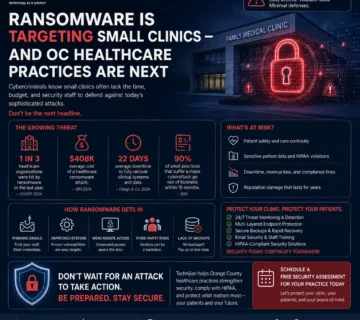
The OC healthcare sector encompasses hundreds of independent practices, specialty clinics, dental offices, urgent care centers, and medical groups that collectively hold millions of patient records and operate with dramatically lighter cybersecurity controls than the hospital systems that make headlines when they are breached. Attackers know this. Small clinics are increasingly targeted precisely because the pressure to pay is higher and the defenses are weaker.
Ransomware attacks on the healthcare sector surged 36 percent in late 2025. The American Hospital Association’s national cybersecurity advisor has confirmed that any cyberattack disrupting healthcare delivery poses direct patient safety risks, especially in areas where the next nearest hospital may be far away.
The Anubis Ransomware Group: Know Your Adversary
The Anubis ransomware-as-a-service operation is representative of the 2026 threat landscape. Anubis uses double extortion, encrypting files to force operational recovery payment while simultaneously stealing data to threaten public release if the ransom is not paid. In the Brockton Hospital case, Anubis claimed 2TB of patient data and added the hospital to its dark web leak site with a countdown clock showing when the data would be published.
This approach maximizes pressure on healthcare operators in two ways simultaneously. The operational crisis demands immediate payment to restore patient care capability, while the data theft threat creates HIPAA breach liability that can survive even a successful recovery. Organizations that pay the ransom to restore operations still face the ongoing data extortion threat.
The Patient Safety Dimension Every OC Practice Must Understand
Cybersecurity discussions in healthcare often focus on HIPAA compliance and financial risk. The UMMC attack adds a dimension that is harder to quantify but impossible to ignore: patient safety. Research into the health impact of hospital ransomware attacks documents a tenfold increase in risk of death for patients experiencing time-critical emergencies at hospitals affected by ransomware-related ambulance diversions. Stroke and cardiac event outcomes worsen measurably when patients are routed to alternate facilities or experience delays in imaging and diagnostic access.
For a clinic operator in Orange County, this reframes the cybersecurity conversation entirely. This is not just about protecting data or avoiding regulatory fines. An unmitigated ransomware attack is a potential patient safety event, and that changes the moral and legal calculus around what level of security investment is appropriate.
Five Lessons From the 2026 Hospital Ransomware Wave
Lesson 1: Recovery Takes Weeks, Not Days
Signature Healthcare confirmed it would remain under downtime procedures for at least two weeks after the April 6 attack. For a small OC clinic with no disaster recovery plan, two weeks of paper-based operations means lost revenue, patient attrition, and staff burnout. Recovery timeline is determined largely by preparation quality. Organizations with tested backups and documented downtime procedures recover in days. Those without recover in weeks or months.
Lesson 2: Paying the Ransom Does Not End the Problem
Double extortion means the decision to pay or not pay is complicated. Paying the encryption ransom may restore operations, but the stolen patient data remains in the attacker’s possession. Anubis and similar groups monetize this data separately. HIPAA breach notification obligations persist regardless of whether the ransom is paid.
Lesson 3: Ambulance Diversion Is a Real Operational Outcome
In both the UMMC and Brockton Hospital attacks, ambulances were physically diverted to alternate facilities. This is the operational reality of healthcare ransomware. It does not just affect IT systems, it affects physical patient care delivery. Every healthcare organization should define their care continuity plan before an attack, not during one.
Lesson 4: Federal Response Is Investigative, Not Protective
In the UMMC attack, the FBI surged resources both locally and nationally. Federal response is investigative; it helps attribute the attack and potentially disrupt the criminal group. It does not restore your systems faster. Prevention and internal response capability are the only defenses that matter in the first 24 to 72 hours of an attack.
Lesson 5: Your Third-Party Vendors Are Attack Vectors
The Change Healthcare breach in 2024 entered through a third-party payment processing vendor and became the largest healthcare cyberattack in US history. Every OC clinic connected to an EHR, billing system, lab interface, or scheduling platform has third-party risk that must be actively assessed and contractually managed.
What OC Healthcare Practices Should Do This Week
- Run a current backup test: restore a subset of data from your most recent backup to verify it works before you need it
- Audit your remote access: list every device and credential with access to your clinical network, including expired VPN accounts and forgotten remote desktop sessions
- Review your downtime procedures: document how your team will function on paper if systems go offline for two weeks
- Assess your third-party vendor security: request security documentation from every vendor with network access to your patient data
- Enable MFA everywhere: email, EHR login, VPN, billing platform, and every clinical application
- Contact Technijian for a HIPAA security risk assessment: our team identifies vulnerabilities before attackers do and provides a budget-aligned remediation roadmap
Technijian’s Healthcare Cybersecurity Services
Technijian has provided HIPAA-compliant managed IT and cybersecurity services to Orange County healthcare practices for over a decade. Our healthcare clients receive 24/7 security monitoring with healthcare-specific threat intelligence, immutable air-gapped backup systems that ransomware cannot reach, tested incident response plans with documented downtime procedures, endpoint detection and response tuned for healthcare environments, annual HIPAA security risk assessments with documented remediation tracking, and staff phishing simulation training aligned to healthcare-specific attack patterns.
🏥 The next hospital ransomware headline could be an OC practice. Contact Technijian today for a free HIPAA cybersecurity risk assessment. Call (949)-379-8500 or visit technijian.com.