Ransomware Is Targeting Small Clinics And OC Healthcare Practices Are Next
🎙️ Dive Deeper with Our Podcast!
Introduction
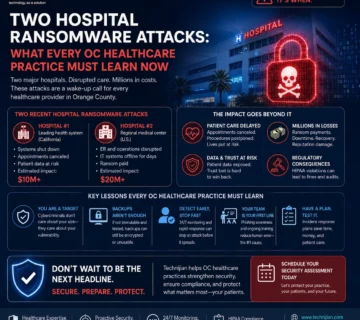
The ransomware groups that crippled hospital networks like UnitedHealth’s Change Healthcare and the University of Mississippi Medical Center didn’t only target large institutions. Their next priority is smaller: community clinics, dental practices, private medical offices, and specialty care providers that collectively serve millions of patients and operate with a fraction of the cybersecurity resources of their enterprise counterparts.
For healthcare practices throughout Orange County — from Santa Ana urgent care centers to Newport Beach concierge practices to Irvine specialty clinics — the ransomware threat in 2026 is not theoretical. It is the most operationally disruptive cyberattack category in healthcare today, and small clinics are being deliberately targeted because attackers know they are under-defended.
Why Ransomware Groups Target Small Clinics
High Pressure to Pay
Small clinics operate on tight margins with no tolerance for downtime. When electronic health records go offline, clinical workflows collapse. Prescriptions cannot be filled, appointments cannot be accessed, diagnostic results cannot be retrieved. The operational pressure to restore systems quickly makes small clinic operators more likely to pay ransoms than large health systems that can sustain manual procedures for weeks.
Weaker Security Posture
Enterprise hospitals have dedicated security operations centers, compliance officers, and enterprise-grade endpoint protection. Most small clinics in OC rely on off-the-shelf software, basic firewalls, and IT managed by staff who have multiple other responsibilities. Attackers know exactly what security controls to expect and how to bypass them.
Rich Patient Data
Medical records are the most valuable data type on the dark web, worth 10x a credit card number. A small clinic with 5,000 patients holds a significant data asset. Ransomware groups using double extortion encrypt files AND steal data, monetizing this asset twice: through the ransom demand and again by selling stolen patient records.
Third-Party Software Vulnerabilities
Many small OC clinics use third-party billing systems, EHR platforms, and scheduling tools that connect to their core network. These integrations are prime attack vectors. The Change Healthcare breach in 2024 demonstrated how a single vendor compromise can cascade through thousands of downstream healthcare organizations simultaneously.
Real-World Impact: What Ransomware Does to a Small Clinic
- Electronic health records become inaccessible — clinical staff revert to paper
- Prescription processing halts — patients cannot refill critical medications
- Appointment scheduling collapses — patients face delays for time-sensitive care
- Medical imaging and diagnostic results become unavailable
- HIPAA breach notification obligations trigger — affecting patient trust and regulatory exposure
- Revenue cycle halts — billing and insurance claims cannot be processed
- Recovery costs average $1.3 million for small-to-mid healthcare organizations
The 2026 Ransomware-as-a-Service Landscape
Ransomware is no longer the exclusive domain of sophisticated nation-state actors. Ransomware-as-a-Service (RaaS) platforms like Anubis, Qilin, and LockBit allow relatively low-skill attackers to deploy hospital-grade ransomware by paying a subscription fee. This democratization means that a small OC dental practice faces the same ransomware toolkit as a major health system, without the same defenses.
Ransomware attacks on healthcare surged 36% in late 2025, with over 60 new ransomware variants identified. The Anubis group, which claimed the April 2026 Brockton Hospital attack, specifically targets healthcare organizations of all sizes, stealing data before encrypting files to maximize extortion pressure.
HIPAA and Ransomware: Your Legal Exposure
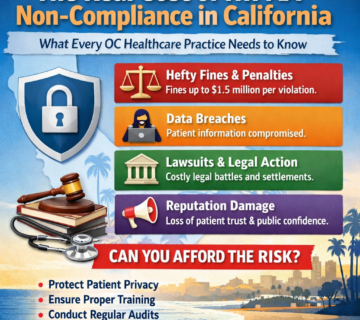
Many clinic operators assume ransomware is primarily an operational problem. It is also a legal one. Under HIPAA, a ransomware attack that results in unauthorized access to protected health information (PHI) is presumed to be a reportable data breach, requiring notification to affected patients, HHS OCR, and in some cases the media, unless you can demonstrate through a thorough risk assessment that PHI was not accessed or exfiltrated.
The cost of this process, including forensic investigation, legal counsel, breach notification, credit monitoring for affected patients, and HHS investigation response, routinely exceeds the cost of the ransomware payment itself. And HIPAA fines for inadequate security controls can reach $1.9 million per violation category per year.
The Ransomware Kill Chain: How Attackers Get In
Step 1: Initial Access
Phishing emails remain the number one ransomware entry point for small clinics. Staff clicking malicious links or opening weaponized attachments gives attackers their initial foothold. Unpatched VPN vulnerabilities and exposed remote desktop protocol (RDP) ports are the second and third most common entry vectors.
Step 2: Lateral Movement
Once inside, attackers spend days or weeks quietly mapping your network, escalating privileges, and identifying your backup systems. This dwell time, averaging 24 days in healthcare, is when the attack is won or lost. Attackers who reach your backups before detection can ensure that even a clean restore will not save you.
Step 3: Data Exfiltration
Patient records, financial data, and operational files are copied to attacker-controlled servers before encryption begins. This is the data that funds the double extortion demand: pay the ransom or your patients’ records get published.
Step 4: Encryption and Ransom Demand
Files are encrypted, systems go offline, and a ransom note appears demanding cryptocurrency payment, typically ranging from $50,000 to $500,000 for small healthcare organizations, in exchange for decryption keys and a promise not to publish stolen data.
How Technijian Protects OC Small Clinics from Ransomware
- Email Security: AI-powered phishing detection and attachment sandboxing that blocks ransomware delivery before it reaches staff
- Endpoint Detection & Response (EDR): Real-time behavioral monitoring that identifies ransomware activity before encryption begins
- Network Segmentation: Isolating clinical systems so that a compromise in one area cannot spread to EHR and billing systems
- Immutable Backups: Air-gapped backup systems that ransomware cannot reach, encrypted and stored off-site
- 24/7 SOC Monitoring: Our security operations team monitors your clinic around the clock, detecting lateral movement and data exfiltration that precede ransomware deployment
- Incident Response Planning: A tested, HIPAA-compliant response plan so that if an attack occurs, recovery is measured in hours, not weeks
- Staff Security Training: Quarterly phishing simulations and security awareness training for all clinic staff
The Cost of Prevention vs. The Cost of Recovery
The average cost of a ransomware recovery for a small-to-mid healthcare organization in 2025 was $1.3 million, including forensic investigation, system restoration, regulatory response, lost revenue, and patient notification. HIPAA fines for inadequate controls can add significantly to this total.
Technijian’s HIPAA-compliant managed security service for an OC medical clinic typically costs a fraction of a single ransomware incident. The ROI is not just financial, it is the ability to continue providing uninterrupted care to your patients.
🏥 Protect your OC medical practice before the next ransomware wave hits. Contact Technijian for a free HIPAA security risk assessment. Call (949)-379-8500 or visit technijian.com.